
For decades, the “27 Club” has loomed over popular music as a grim roll call of musicians who died at 27. From Jimi Hendrix and Janis Joplin to Kurt Cobain and Amy Winehouse, the pattern feels eerie. Too eerie to be a coincidence.
Today, on what would have been Cobain’s 59th birthday, it’s hard not to wonder how different music history might look if he had lived past 27.
But is 27 actually a statistically dangerous age for musicians?
To find out, I compiled data on more than 6,000 deaths in popular music between 1950 and 2025, tracking age at death and cause of death. The results show something surprising: while 27 does show a small spike, it’s far from the deadliest age in music. And the real story is much bigger.
Key Findings
- Age 27 shows a noticeable bump (67 deaths)
- It is not the most common age of death in musicians
- Deaths peak in the 70s
- Cancer and heart disease dominate overall causes
What Is the 27 Club?
The 27 Club is an informal term for a group of musicians who died at the age of 27. It’s not a real organization, just a cultural label that formed after several high-profile artists passed away at the same age.
Here are a few well-known members of the 27 Club death list…
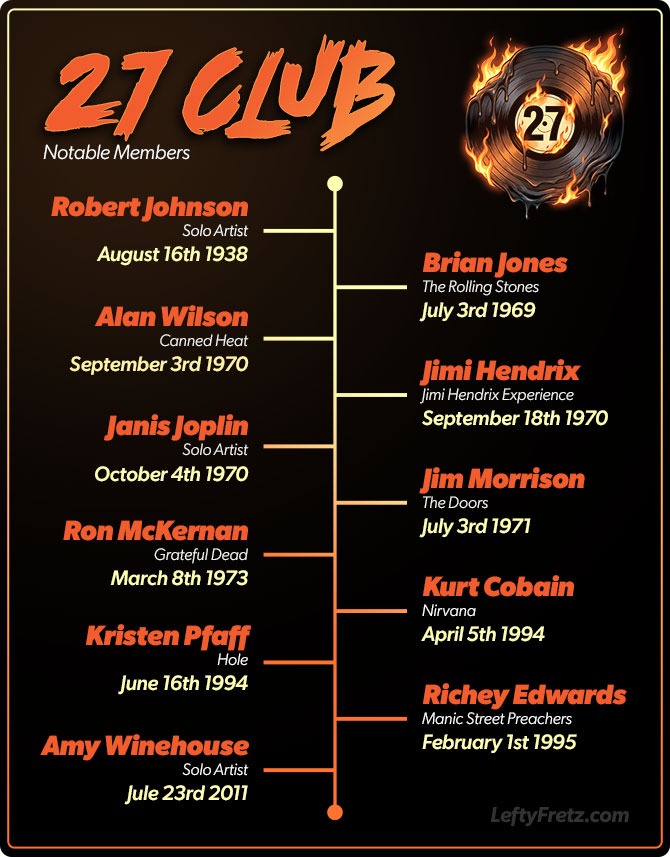
27 Club members include figures like Jimi Hendrix, Janis Joplin, Kurt Cobain and Amy Winehouse. Because many of them were hugely influential and died suddenly, the shared age began to feel meaningful.
Over time, the idea took on a life of its own. Media coverage reinforced the pattern, lists expanded, and “27 Club” became shorthand for the darker side of fame. Whether it represents a real statistical phenomenon is another question, but culturally, the label has stuck.
The Data: 6,000 Musician Deaths
To move past anecdotes, I compiled data from Wikipedia’s “Deaths in Popular Music” lists, covering the years 1950 through 2025. In total, the dataset includes just over 6,000 artists connected to popular music.
For each person, I recorded their age at death and grouped their cause of death into broad categories such as cancer, heart-related illness, accidents, drug-related causes, and so on. The goal wasn’t to create a perfect medical study. It was to step back and look at the overall patterns.
There are limitations, however. Wikipedia skews toward artists who were notable enough to be documented, which likely means the data is biased toward English-language and Western musicians. Causes of death are sometimes simplified or reported differently across sources. And this is based on raw counts, not adjusted for how many musicians were alive at each age.
Still, with more than 6,000 cases across 75 years, the dataset is large enough to show meaningful trends. It allows us to answer a basic question: when musicians die, how old are they?
And that’s where things start to get interesting.
Does 27 Show a Spike?
Yes. But it’s smaller than the myth suggests.
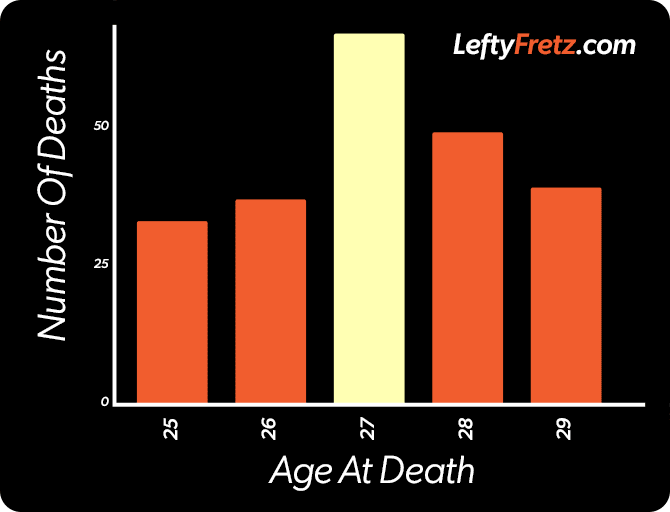
In the dataset, age 27 appears 67 times (1.1% of the total number of deaths). That’s clearly higher than the surrounding years. For comparison:
- 25: 33 deaths (0.54%)
- 26: 37 deaths (0.61%)
- 27: 67 deaths (1.1%)
- 28: 49 deaths (0.8%)
- 29: 39 deaths (0.64%)
So 27 does stand out within the late 20s. It’s almost double 25 and well above 26.
But zoom out and the picture changes.
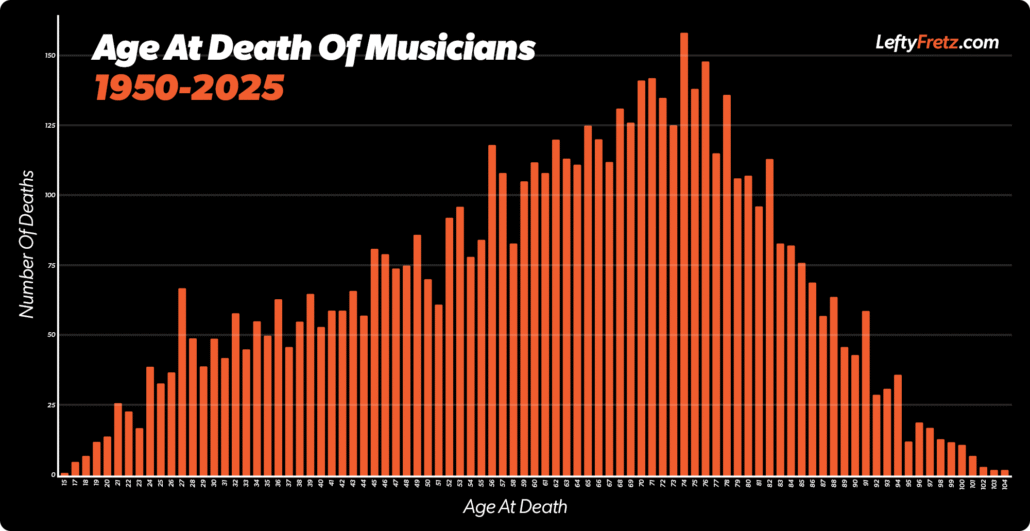
Deaths generally rise from the early 20s into the 30s. Age 24 has 39 deaths. Age 28 has 49. Age 30 also has 49. In other words, 27 isn’t an isolated cliff. It sits inside a broader upward slope.
More importantly, it’s nowhere near the highest point in the dataset. Several ages in the 70s show well over 130 deaths. If we’re asking what the most common age of death in popular music is, 27 doesn’t come close.
There is a bump. That’s real. The question is whether that bump represents something uniquely dangerous about 27, or whether it feels larger because we already expect it to be there.
A 2011 study published in the British Medical Journal examined musician mortality and found no statistically significant increase in deaths at age 27 compared with surrounding years.
The Real Peak Ages in Music
If 27 isn’t the most common age of death, what is?
In this dataset, deaths rise steadily through middle age and peak much later in life. The highest numbers appear in the 60s and 70s. For example:
- 65: 125 deaths (2.1%)
- 68: 131 deaths (2.2%)
- 70: 141 deaths (2.3%)
- 74: 158 deaths (2.6%)
- 76: 148 deaths (2.4%)
In fact, 74 is the single highest age in the entire dataset.
That may sound obvious. People tend to die later in life. But it’s an important context. The overwhelming majority of musician deaths follow the same pattern as the general population: mortality increases with age.
The cultural focus on 27 can make it feel like musicians are uniquely doomed in their 20s. The data suggests something far less mysterious. Most artists survive their early fame. Most grow older. And most eventually die from the same age-related causes as everyone else.
CDC mortality trend data shows that death rates increase steadily with age, which helps explain why the largest counts in my dataset cluster in older decades.
How Musicians Actually Die
The stereotype is clear. Rock stars burn bright and die young, usually in a haze of drugs, alcohol, or self-destruction.
The data tells a different story when we examine the causes of death.
A quick caveat: the largest category in my dataset is “other” (2,044 cases), which includes a long tail of rarer causes as well as reasons that were not recorded. Even so, among the clearly defined categories, the two biggest are cancer (1,236 or 20.3%) and heart-related illness (1,068 or 17.5%). Together, they account for a substantial share of all deaths. And they underline the main point: in raw numbers, most musicians die from ordinary, age-related illness, not the rock-and-roll stereotype.
That doesn’t mean the “rock and roll” causes aren’t there. Drug-related deaths account for 179 cases (2.9%). Alcohol-related causes add another 103 (1.7%). Suicide accounts for 117 (1.9%). These are significant and tragic numbers.
But they are far from dominant.
Accidents also play a noticeable role. There are 256 traffic-related deaths (4.2%) and 70 plane crashes (1.1%), reflecting the realities of touring and constant travel. Violence appears too, with 202 recorded murders (3.3%).
Still, when you step back, the overall pattern is surprisingly ordinary. Age-related illness outweighs excess. Long careers outweigh early collapse.
The mythology of Club 27 focuses on dramatic, early deaths. The data shows that most musicians live long enough to face the same health risks as everyone else.
Why Club 27 Feels Bigger Than It Is
If 27 isn’t the deadliest age, why does it loom so large?
Part of the answer is emotional, not statistical.
Deaths in someone’s 70s rarely become mythology. They feel expected, even when they’re sad. But when a hugely influential artist dies at 27, it interrupts a story that feels unfinished. There’s a sense of lost potential. We imagine the albums that were never made, the tours that never happened.
There’s also the power of repetition. When several iconic figures share the same age, the pattern sticks. Each new case reinforces the last. Over time, the number itself becomes symbolic.
Media coverage amplifies that effect. Headlines highlight the shared age. Retrospectives link artists together. Lists get republished. The “club” becomes a narrative shortcut.
And humans are wired to notice patterns. Once we’re aware of 27 as a meaningful number, every new case feels like confirmation.
A well-known psychology study found that people are wired to see patterns in small clusters of events, even when those patterns might just be coincidence.
The data shows a modest bump. Culture turns that bump into a legend.
Is the 27 Club Real?
Yes, in the narrowest sense. Age 27 shows a clear bump in the data. It stands out.
But it doesn’t dominate the numbers, and it doesn’t define the overall pattern of musician mortality.
What makes 27 powerful isn’t just frequency. It’s symbolism. It captures something culturally potent: talent interrupted, potential unrealized, a life frozen at its most mythic stage.
The statistics show a modest spike. The culture turned it into a legend.
And maybe that’s the real answer. Club 27 is less a statistical anomaly than a story we continue to find meaning in.
Frequently Asked Questions
Is the 27 Club statistically real?
Age 27 does show a noticeable bump in the data, with 67 recorded deaths in this dataset. However, it is not the most common age of death in popular music. Deaths increase steadily with age and peak much later in life, especially in the 60s and 70s.
How many musicians died at 27?
In this analysis of more than 6,000 deaths between 1950 and 2025, 67 musicians died at age 27. That makes it higher than nearby ages like 25 and 26, but far lower than peak ages later in life.
What is the most common age musicians die?
Based on this dataset, deaths peak in the mid-70s. Age 74 has the highest recorded number of deaths. Overall, most musicians die in their 60s and 70s, not in their 20s.
What do most musicians die from?
The most common clearly defined causes of death in this dataset are cancer and heart-related illness. While drug-related deaths, alcohol-related causes, and suicide do occur, they account for a much smaller share of total deaths than age-related diseases.
Why does the 27 Club feel so significant?
Deaths at 27 tend to involve highly influential artists whose careers were still rising. Because these deaths are sudden and dramatic, they receive more media attention. Over time, repetition has turned a statistical bump into a cultural myth.


