

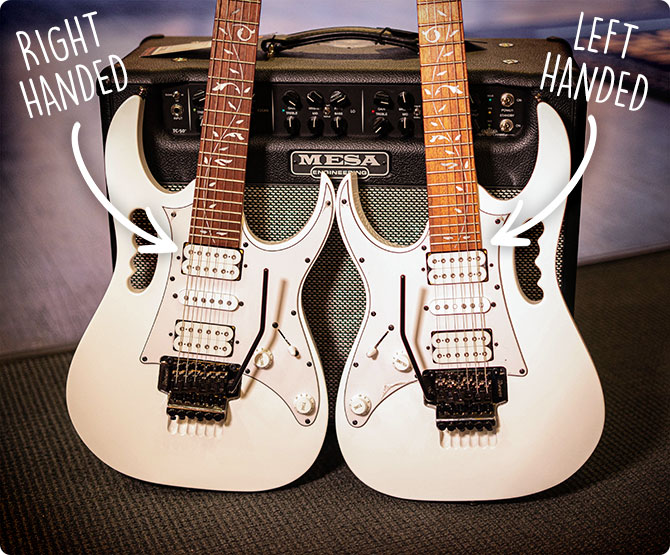
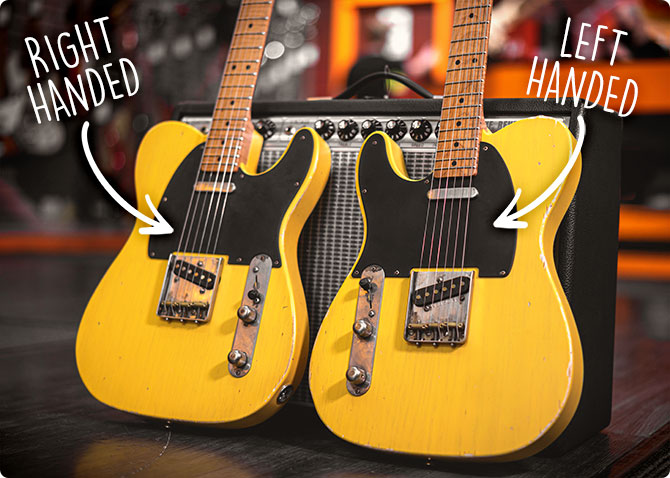
The difference between a left handed and right handed guitar is the way everything is oriented. A left handed guitar is essentially a mirror image of a right handed one, with the entire instrument built in reverse rather than the strings being rearranged.
In this guide, I’ll show you exactly how left and right-handed guitars differ, how to tell them apart, and what those differences actually mean when you’re playing.
If you’re unsure which one you should play, you might also want to read my guide on whether you should learn guitar left or right handed.
Quick Answer: Left vs Right Handed Guitar
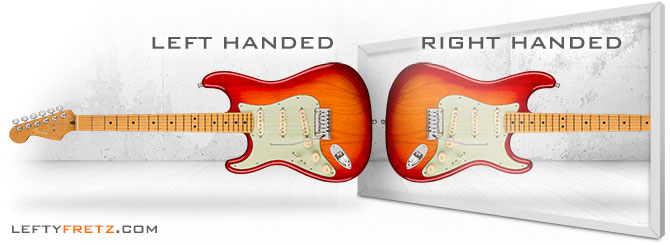
A left handed guitar is simply a mirror image of a right handed guitar. The entire instrument is built in reverse so it can be played with the left hand picking and right hand fretting. The string order relative to the player stays the same, although a small minority of players do choose to play with the strings reversed.
What Does this Difference Actually Mean in Practice?
While the core difference is that the guitar is a mirror image, that change affects several practical details. Here’s how a left handed and right handed guitar differ when you actually look at and play them.
String Orientation
On both left handed and right handed guitars, the string order stays the same relative to the player. So, when playing, the thickest string (low E) is closest to your head, and the thinnest string (high E) is nearest to your feet.
This is because a left handed guitar is built as a flipped version of a right handed one, rather than being restrung differently. However, some players do choose to play a right handed guitar upside down, which does reverse the string order in practice.
See my guide on how to string a left-handed guitar.
Body Shape and Cutaways
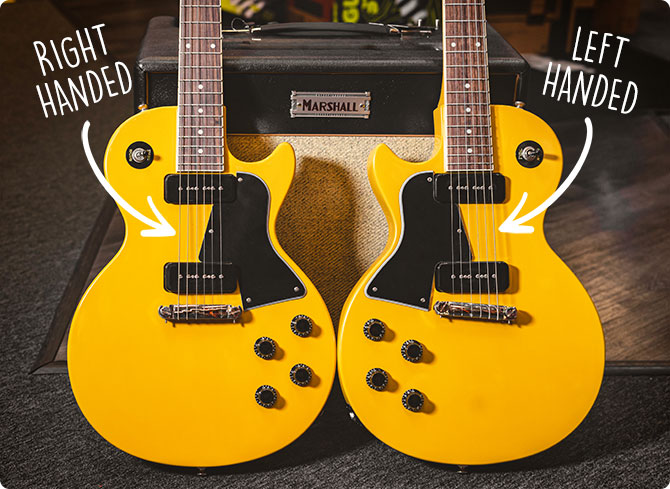
The body shape is reversed, so it suits the opposite playing position. On guitars with a cutaway, this means the cutaway appears on the opposite side, allowing access to the higher frets for the fretting hand.
This is one of the easiest visual ways to tell whether a guitar is left or right handed. Check out the photo of the two yellow Les Paul guitars above for a good example.
Controls and Hardware Placement
On electric guitars, the position of the controls is also reversed. Volume and tone knobs, pickup selectors, and input jacks are all placed so they are easy to reach with the player’s picking hand.
On acoustic guitars, this difference is less noticeable, although features like pickguards will still be positioned for the opposite hand.
Playing Position
The playing position is completely reversed. A right handed player frets notes with their left hand and strums with their right, while a left handed player does the opposite.
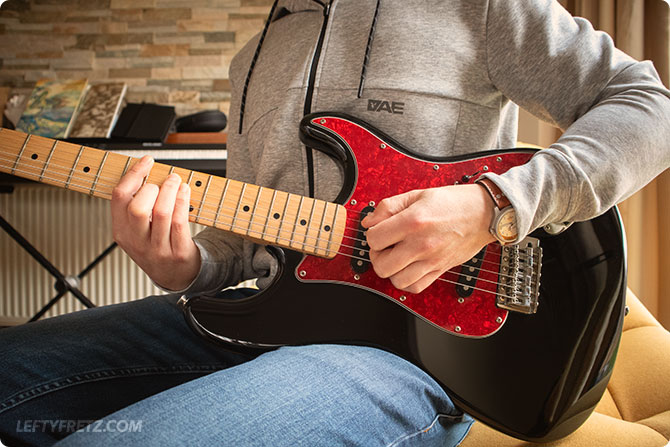
Some left handed players choose to use a right handed guitar instead, by playing it upside down and restringing it. However, without those adjustments, a right handed guitar is not designed to be played left handed.
In the image below, I am holding a right-handed guitar upside down to play left-handed. The strings are the wrong way around, the controls are poking into my picking arm, and I’ve lost a lot of upper fret access. You can see why so few players decide to learn this way!
How to Tell if a Guitar is Left or Right Handed
You can usually tell whether a guitar is left or right handed just by looking at a few key features. Here are the easiest ways to identify it at a glance.
For all of these methods, hold the guitar vertically in front of you. Doing it this way will mean that you can walk into a guitar store and easily pick out the lefty models hanging on the walls.
Look at the String Thickness
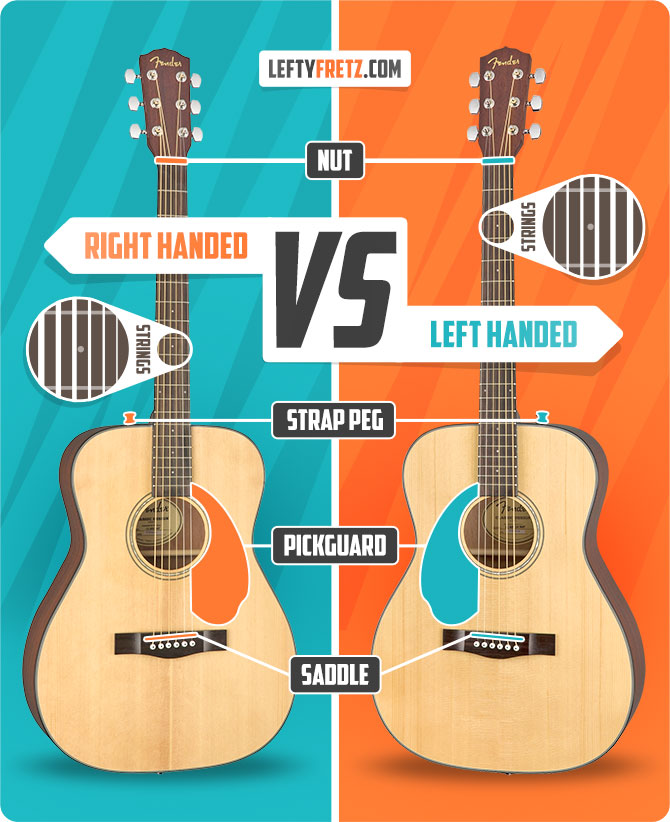
If the thickest string is on the right, the guitar is a lefty, and if it’s on the left, it’s a righty.
However, as we’ve already touched on above, some players do play with the strings reversed. So this test might not always be 100% accurate.
Look at the Controls and Pickguard
If your guitar has them, look at the pickguard and/or controls.
On a left handed guitar, they are on the left, and on a right handed model they should be on the right (when facing you).
Related Article: Guide To All Parts Of The Guitar
Check the Cutaway
On guitars with a cutaway, the shape will be on the side that gives your fretting hand access to the higher frets.
If the cutaway is on the left, the guitar is left-handed. If it is on the right, it is right-handed. Keep in mind that many guitars do have two cutaways, so we need to look at the one on the lower side (nearest the thinnest string).
Check Out the Nut Grooves
The nut is the thin strip of material near the headstock end of the fretboard which holds the strings in position. Each slot in the nut is a different width to accommodate each string snugly.
On a left-handed guitar, the widest nut slot will be on the right. The reverse is true for a right-handed axe.
Where are the Strap Pegs?
Although some guitars may only have one (or none!), the strap pegs are the little metal feet that you slot your guitar strap over.
On most guitars, the rear peg will be in the center of the body, but the front peg will be on the top side. If the front strap peg is on the right, it is left-handed. A strap peg on the left indicates a right-handed guitar.
Examine the Fretboard Side Markers
The side markers are the little dots you’ll usually (but not always!) find on the side of your fretboard to help indicate fret positions.
You will find these on the top side of the fretboard, facing you when in a playing position. So, in our vertical position, the dots will be on the right-hand side of a lefty instrument.
Look at the Saddle Angle
On an acoustic guitar, the saddle is the thin strip of material on top of the bridge on which the strings sit.
One of its functions is to correctly set the intonation on the instrument. To achieve this, the saddle is set at an angle to slightly alter the length of each string.
On a standard guitar, the saddle is angled so that the thickest string has the longest length. On a left-handed guitar, the lowest side of the saddle will be on the right.
To Sum Up
The difference between a left handed and right handed guitar is simple: one is a mirror image of the other. Once you understand that, everything else, from string orientation to body shape, falls into place.
If you’re choosing between the two, the most important factor is which one feels natural to play. Next up, read my guide that explains whether you should learn left or right-handed guitar.
Frequently Asked Questions
Yes, but the difference is mainly in how the guitar is built. A left handed guitar is a mirror image of a right handed one, so it can be played from the opposite side.
Yes, but it usually requires adjustment. Some players flip the guitar upside down or restring it, although this can affect playability and comfort. Read my guide to restringing a right-handed guitar upside-down for more information.
Yes. A left handed guitar is essentially a reversed version of a right handed guitar, with the body shape and hardware positioned for the opposite hand.
You can usually tell by looking at the string orientation, body shape, and control placement. These features are arranged differently depending on whether the guitar is designed for left or right handed players.
They can be more expensive due to lower demand and production volume, but the difference varies depending on the brand and model.
For a full breakdown, see my guide on why left handed guitars are more expensive.
Absolutely not. If you’re unsure which way to start, see my guide on whether you should learn guitar left or right handed.
Left-handed guitars are generally less common in stores and online due to lower demand, which means fewer models are available compared to right handed guitars. Check out my left handed guitar database to help find your next instrument!

