

Trying to decide whether you should play guitar left handed or right handed? This is one of the most important decisions you will make as a beginner, and getting it right from the start can make learning much easier.
There is a lot of advice online about whether left handed beginners should learn guitar left handed or right handed, but not all of it is helpful.
The truth is that there is no single answer that works for everyone. The right choice depends on how the guitar feels in your hands and which orientation gives you the most natural sense of control.
Quick Answer: Should You Play Left or Right Handed?
If you are unsure whether you should play guitar left handed or right handed, the answer usually comes down to which hand naturally takes the lead.
If your left hand feels more natural strumming, you should play left handed. If your right hand feels more natural, you should play right handed.
If you genuinely feel no strong preference, most beginners choose to play right handed simply because it is more common.
How to Decide Which Way to Play Guitar
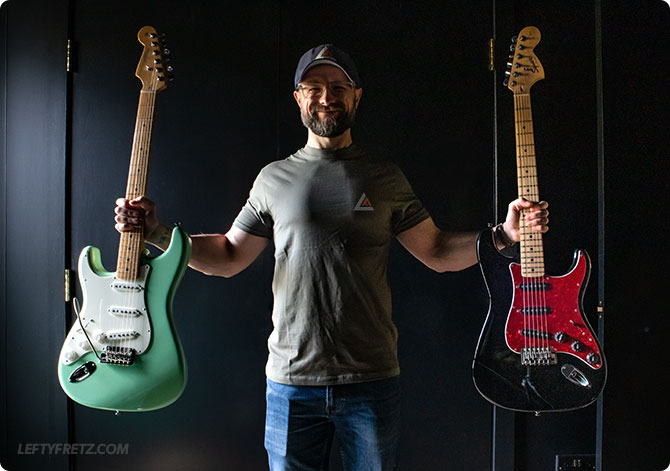
While there are certainly differences between left handed and right handed guitars, the most important factor is which way feels natural to you.
The best approach is to trust your instincts rather than overthinking the decision.
Here are a few questions we can look at to help you make an informed decision when it comes to left handed vs right handed guitar playing.
Should a Left-Handed Person Play Guitar Right-Handed?
Many people ask whether a left handed person should play guitar right handed. The answer is that, yes, a left handed person can play guitar right handed, and many people do! This includes famous players such as Gary Moore and Mark Knopfler.
However, this decision should not be based on what others have done, but on what feels most natural to you.
It is common for beginners to follow advice that pushes them toward playing right handed, even if it does not feel completely comfortable. So, lets look at how you can avoid making this mistake.
Here’s a simple test you can try to help answer the question of left handed vs right handed guitar playing.
Left or Right Handed Guitar Test
Grab an imaginary guitar and pretend to play without thinking about it.
Which hand naturally takes the lead when you strum?
If your left hand feels more comfortable strumming/picking, you should play left handed. If your right hand feels more natural, you should play right handed.
Another simple test is to watch how you clap your hands. The hand that does most of the movement is usually the one best suited for strumming.
If you do not notice a strong preference either way, most beginners choose to play right handed simply because it is more common.
The key is to go with what feels the most natural from the start when choosing whether to play guitar left handed or right handed.
Which Hand Matters More When Playing Guitar?
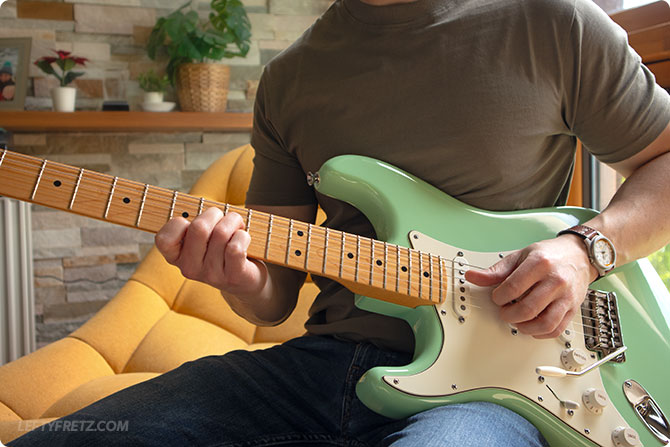
The strumming hand absolutely has the most difficult job, as it requires more precise coordination and rhythm than the fretting hand. This is why your dominant hand is traditionally the picking/strumming hand on guitar.
The single piece of advice that really frustrates me is the old “you’ll be at an advantage having your dominant hand doing the fretting“.
Think about that for a second.
If that were true, why are all right handed players not playing left handed? Why is a left handed guitar not the norm?
It simply does not hold up in practice.
Should You Follow Advice to Learn Right-Handed?
As a left-handed person looking into the instrument, you may be given advice online or in music stores to learn guitar right handed.
In a guitar store, the salesperson may try to push you towards a right handed guitar for purely selfish reasons. Either because they will receive a higher bonus for selling certain guitars, or because they know they will have fewer instruments to sell you in the coming years if you opt for a lefty.
I was lucky, as when my parents took me to get my first electric guitar the salesman let me try both a left handed and right handed guitar. The difference was night and day for me, making the decision very simple.
In other cases, this recommendation is based on convenience rather than what is best for you as a player. Right handed guitars are far more common, so they are often suggested as the default option.
My advice is to ignore everyone else’s advice.
Again, the most important factor is how natural the instrument feels in your hands. That should always come first.
Does Availability Affect Your Decision?
Availability used to be a bigger issue for left handed guitar players when I first started playing. It was common to walk into a guitar store to find just one lonesome lefty model, usually a black Stratocaster!
However, that is no longer the case.
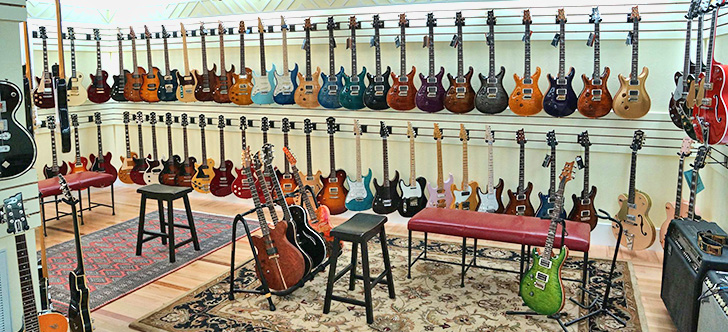
While there are still fewer left handed models available, there are more than enough options for beginners and experienced players alike.
Take a look at the huge range of left handed guitars available online currently. For example, you can browse hundreds of left handed guitars on Amazon alone!
Does Price Matter When Choosing Left or Right Handed?
Some left handed guitars can cost slightly more than right handed models, but the difference is usually small – often 10-15% at most. However, that also means that these guitars are worth more if you decide to sell them later on. It all evens out!
Price should not be the deciding factor when choosing how to play.
Playing the way that feels natural will have a much bigger impact on your progress than a small difference in cost. Plus, many brands do not upcharge for lefty models, so this may not even be an issue for you!
If you’d like to learn exactly why some brands charge more, check out my article – Why are left-handed guitars more expensive?
Does Learning Left or Right Handed Affect Difficulty?
Learning guitar left handed is not inherently harder than learning right handed.
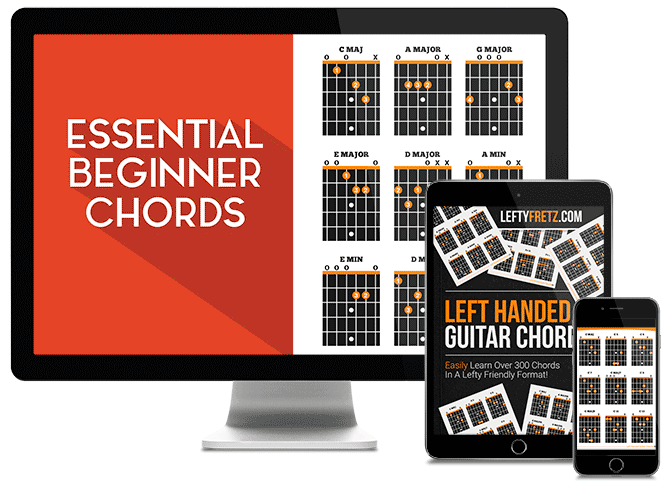
Tabs are not backward, learning materials are not backward, and it makes no difference to a (good) guitar teacher if you are left handed. A minor difference is that chord diagrams are designed with righties in mind, but you can check out my left-handed chord diagrams to make sure you get an easy start.
The main difficulty comes down to how natural the orientation feels for you.
If you choose the wrong way, certain techniques can feel awkward and slow your progress over time.
If you want a deeper breakdown of this topic, check out my full guide on whether it is harder to learn guitar left handed.
What Happens If You Choose the Wrong Way to Play?
In the past, left handed children were forced to write with their right hand.
As a result, many struggled with handwriting and never developed the same level of control as they would have using their natural hand. Well, the same idea applies to guitar!
If you choose the wrong way to play guitar, it might not feel like a problem at first. In the early stages, most beginners can make progress regardless of orientation.
However, as you improve, differences in coordination and control can start to show.
Your picking hand plays a major role in timing, rhythm, and overall feel. If this hand is not your natural dominant hand, certain techniques may feel more difficult over time.
This can lead to slower progress and unnecessary frustration.
This is something experienced educators have also observed. Here is a great quote from Bruce Dickinson, founder of the prestigious Brighton Institute of Modern Music:
I’ve seen many lefties who play right-handed and have difficulties later on because their picking/strumming hand is the less sensitive and controlled of the two. Typically, if they are fully left handed, their sense of rhythm in the right hand will be less developed or just unmanageable. This problem, which does not build up until later along the learning curve, can be an insurmountable obstacle. This is why I don’t recommend that left handers learn to play right handed unless they feel very comfortable with it.
Over the years, I have received countless emails and comments from people who have struggled (sometimes for years!) playing right handed, only to try out southpaw mode and suddenly have a complete epiphany.
As if by magic, everything falls into place, and they start progressing at a pace that they could only have dreamed about beforehand.
Final Answer: Play the Way That Feels Natural
The answer is simple. You should play guitar left handed or right handed based on what feels most natural to you.
No one else can make this decision for you, and there is no universally correct choice.
Your comfort, coordination, and long-term progress will always be better when you follow your natural instincts.
Take a moment to try the simple test I laid out earlier in this guide and trust what feels right. Once you have made your decision, the next step is getting started the right way.
If you decide that you are a left handed guitar player, then a good place to start is my beginner left-handed guitar series of guides.
Also make sure to check out 9 Amazing Advantages Of Playing Guitar Left-Handed.
Is It Harder To Learn Bass Left Handed?
It is no harder to learn bass left-handed than to learn right-handed.
The only real difference is that it will be a little harder to find a left-handed bass, as more people tend to gravitate towards playing guitar, so the market is much smaller.
Aside from this, everything else we have already discussed in this article will also apply to bassists.
Make sure to check out my beginner left handed bass guide if you are currently considering your first instrument.
Next Steps

Now that you (hopefully) know which way you are going to play, check out my 9-part Beginner Guitar Guide where you’ll learn everything that you need to know to get started with guitar or bass!
This series of guides is relevant to both left and right handed players and includes gear recommendations for beginners.
Good luck, and feel free to email me if you require any extra advice. You’ll find a link to our contact form in the footer below.

