

Can you restring a right-handed guitar upside down and play it left-handed? The answer is, of course, ‘yes’, but the question ought to be ‘should I string a right-handed guitar upside down?’.
In my opinion, you should only be considering this if it is the only available choice to you, i.e you have limited cash but do have access to a right-handed guitar or bass.
And even then, I’d suggest selling the guitar if possible and using the funds for a bona fide lefty. The reason I don’t recommend this is due to the plethora of issues that can arise as a result. I’ve detailed just a few of these below…
Can You Restring A Guitar Left-Handed?
Yes, you can restring a right handed guitar upside down in order to play it left handed. However, I would highly recommend trying to source a proper left-handed guitar in order to avoid having to modify the guitar to address several issues that will likely arise.
Here are just a few of the problems you will come across when restringing a right-handed guitar upside down:
1. The Nut Is Back to Front
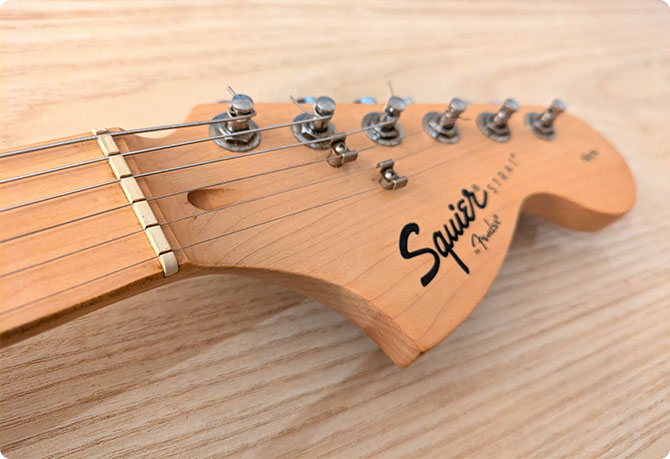
Straight off the bat, you will need to sort out the guitar’s nut (the thin strip of slotted material holding the strings in place just before the headstock).
You might be able to notice in the photo above that the nut is designed to snugly accommodate each string. So, if the guitar is restrung upside down, the strings will be placed in the incorrect slots. You will find that the thicker strings most likely won’t fit into the channels at all, and the higher, thinner strings will rattle around in their new oversized slots, causing all sorts of issues.
To remedy this, you will need to either flip around your current nut or, preferably, buy a new left-handed nut, such as this one.
This is also a job which you would most likely want carried out by a professional guitar tech. I have listed some of the prices for jobs like this at the end of this article.
2. Intonation Will Be Affected
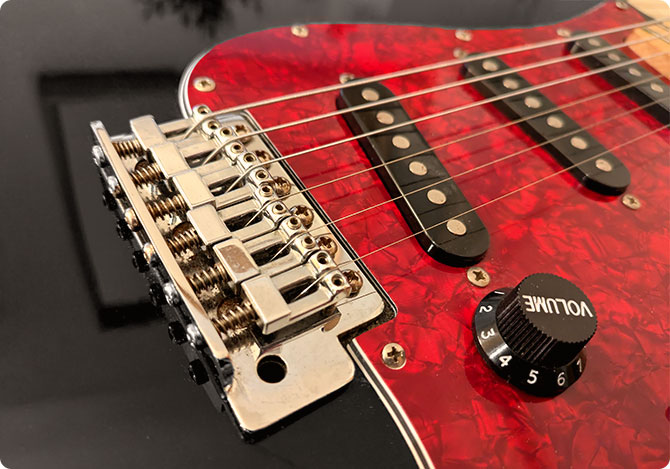
The second potential issue you will need to look at is the bridge, as the intonation will now need to be adjusted. A properly intonated guitar will be perfectly in tune along the entire length of the fretboard.
This is achieved by carefully adjusting the overall length of each string between where they meet the bridge and nut. A difficult task on an upside-down guitar as the angle of the bridge will now be reversed.
For guitars such as Fender Strats, it might be as easy as simply readjusting the intonation screws. This is due to the fact that most Fender-style bridges sit straight across the guitar’s body. So, when flipped over, the inherent intonation points don’t change at all.
However, guitars such as Gibson Les Pauls may have bridges which are slanted at an angle, which makes correctly restringing upside down a more troublesome task. When flipped upside down, the intonation points will change to such a degree that they might be impossible to fine-tune correctly.
The same idea will apply to acoustic guitars, as the saddle is also generally set at an angle. Here, the issue is much harder to fix as there are no intonation adjustments available. In addition, an acoustic saddle generally changes in height from one side to the other. The bass side is usually higher so that the thicker strings do not buzz against the frets.
So, for acoustic guitars, you will ideally need to take the guitar to a tech or luthier to have a new saddle or entire bridge fitted.
3. Hardware In Awkward Positions
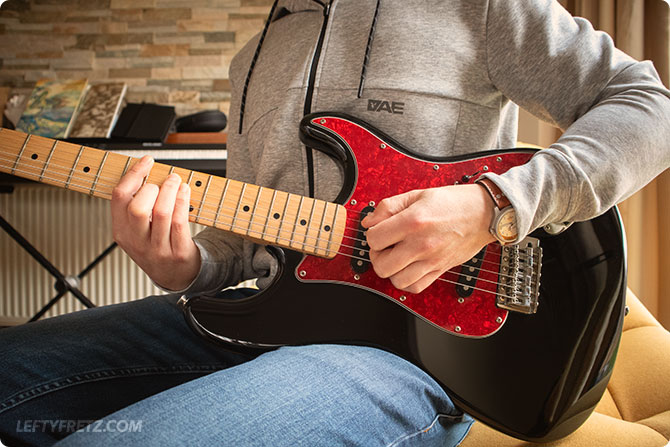
This is a drawback related to electric guitars more so than acoustic guitars.
Consider where the controls on a right-handed electric guitar will be located when you hold it upside down. The volume/tone knobs will be underneath your forearm, as will the pickup selector switch. This will lead to issues such as accidentally moving knobs whilst playing.
If it has one, your guitar’s tremolo bar will be on the opposite side as well. You’ll need to adapt your playing style so as not to accidentally hit the bar and change pitch. Even if you do manage to skirt around the bar, it’s still going to add a lot of unnecessary awkwardness to your playing.
Likewise, your front strap peg will be on the wrong side and will need to be moved if you want to use the guitar with a strap.
Depending on where the input jack is situated, you are also likely to have your guitar lead trying to stab your armpit!
The pots on an upside-down guitar will also operate in the opposite direction to what is considered ‘normal’. Not a big deal, but you can fix this with some very simple rewiring. Either that, or you can actually buy special left-handed pots such as this one.
If the guitar is an electro-acoustic, the EQ/tuner controls would also be hard to read/reach, as they’ll now be located on the underside of the guitar.
4. You Might DAMAGE The Guitar!
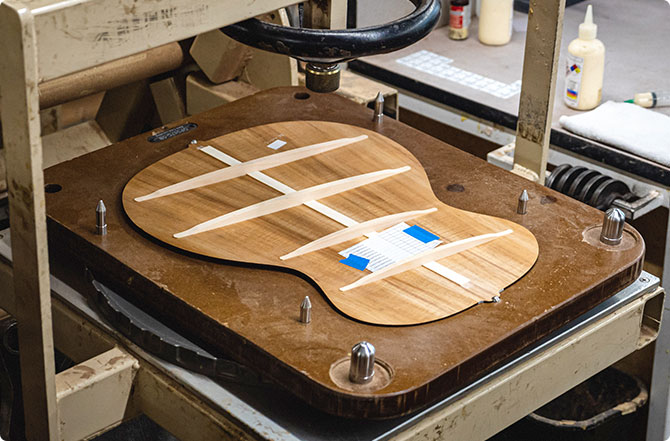
Acoustic guitars are braced internally to accommodate the stronger force of the low strings on one side and the lighter high strings on the other. The bracing is not completely symmetrical. So, if you mess with the string order, you will eventually warp the guitar.
The inner bracing is also designed to optimise the guitar’s sound, so flipping the string order may also adversely affect tone.
In addition, any of the changes we’ve already talked about could potentially damage or ruin the guitar if not carried out properly.
5. Resale Value Will Be Lower

Also, keep in mind that if you mess with the layout of a guitar, you are likely to negatively affect its resale value if you decide to part ways with it later on.
As I’ve touched on above, there are always going to be downsides to a lefty conversion. Finding another southpaw who is happy to play with a converted right-handed guitar might be tricky.
Selling to a righty would probably involve reverting the guitar back to its original state. This could be a potentially costly endeavour depending on how far you take the conversion.
The Tip of the Iceberg

These issues are the main points to consider when thinking about restringing a right-handed guitar left-handed. However, they really are just the tip of the iceberg. I could go on, but I feel I should have made my point already.
It is just not worth the hassle and added expense of going to the effort of re-jigging a right-handed guitar for left-handed playing.
Left handed guitars are generally no more expensive than right handed guitars these days. So, it makes little sense to switch around a righty unless it is just a quick fix or your only available option.
Perhaps 20 or 30 years ago, it would have been the norm for a southpaw to restring their dad’s old guitar. These days, there is no reason to suffer in the age of internet shopping!
If it’s your first guitar and the only instrument you have access to is a right-handed axe, then by all means go ahead and restring it. However, keep in mind that it will never be perfect.
You don’t absolutely have to change the nut, bridge, etc., just to try out the guitar for a few weeks. Hopefully, it will be good enough to give you a decent introduction to guitar, and then you can feel confident in buying your first left-handed model further down the line.
TLDR: Don’t restring a guitar left-handed. If you can – Buy A Left Handed Guitar!
Check out our 8-part Newbie Guide for a list of some excellent left-handed guitar options that won’t break the bank!
My Favorite Lefty Guitar Stores
Disclosure: If you decide to purchase a guitar using the links above, I will earn a small commission at no additional cost to you. Thank you!
How Much Does It Cost To Convert A Guitar To Left-Handed?
But what if your only option is to convert a right-handed guitar for left-handed play? After reading over all of the potential issues above, I’d guess you are probably now wondering how much a professional would charge you for the conversion.
To answer this question, I contacted several well-known guitar stores and took an average of the quotes I received back.
Converting a right-handed electric guitar for left-handed play will cost between roughly $100 and $150. At the lower end, this would just involve making you a new nut, and at the higher range would also include a guitar setup and intonation check.
An acoustic guitar will be slightly more expensive to convert as more work is required. The costs here came back at between $180 and $220 for a left-handed conversion. This would include a new nut as well as a new saddle.
Whether or not this expense is worth it will depend on the value of your guitar!

