

Guitarists who play upside down left-handed are among the most distinctive players in music.
Most left-handed guitarists either buy a left-handed guitar or restring a right-handed model. The players in this list took a different route, often learning on whatever guitar was available and sticking with that setup for the rest of their career.
In this article, we are looking at famous guitarists and bassists who play upside down left-handed, from blues pioneers and rock innovators to soul greats and modern virtuosos.
For this list, I included players who are known to play left-handed with the strings reversed, rather than simply using a standard left-handed guitar.
For a broader list, see my guide to famous left-handed guitarists.
Table Of Contents
- What Does It Mean to Play Guitar Upside Down Left-Handed?
- Guitarists Who Play Upside Down Left-Handed
- More Upside-Down Left-Handed Guitarists and Bassists
- Why Do Some Left-Handed Guitarists Play Upside Down?
- Is Playing Guitar Upside Down Harder?
- Upside Down vs Left-Handed Guitar: What’s the Difference?
- Do Upside-Down Guitarists Use Different Chord Shapes?
- FAQs About Guitarists Who Play Upside Down Left-Handed
What Does It Mean to Play Guitar Upside Down Left-Handed?
Playing guitar upside down left-handed usually means taking a right-handed guitar, turning it over, and playing it left-handed without changing the string order.
That last part is what matters most. A right-handed guitar is normally strung with the low E at the top and the high E at the bottom. When that guitar is flipped over and played left-handed, the order is reversed from the player’s perspective. The high E is now at the top, while the low E is at the bottom.
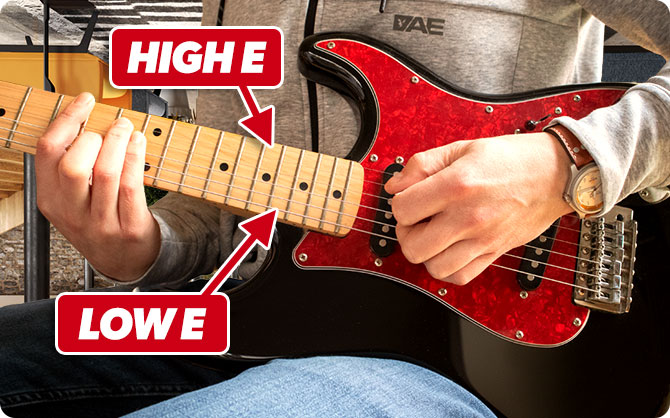
This creates a very different playing experience from a standard left-handed guitar. Open chords, barre chords, scale shapes, string bends, and picking patterns can all feel different because the strings are being approached from the opposite side. Even basic techniques like palm muting, raking, and controlling open strings may need to be adapted.
Because of that, many upside-down left-handed players develop a style that does not look or sound quite like anyone else’s. For the following players, their unorthodox style became part of what made their songs, solos, and overall sound so recognizable.
Guitarists Who Play Upside Down Left-Handed
Below are some of the best-known guitarists who play upside down left-handed, each with their own approach to making a reversed-string setup work.
Eric Gales

Eric Gales is one of the most famous modern examples of a guitarist who plays upside down left-handed. He plays a right-handed guitar flipped over, with the strings reversed from the standard left-handed layout.
Gales learned this way at a young age, following the same general approach as his older brothers, who also played left-handed and upside down. Rather than switching to a conventional left-handed setup later on, he kept the reversed string order and built his entire playing style around it.
That setup is a big part of what makes Gales so interesting to watch. His bends, vibrato, chord shapes, and lead runs often seem to come from a different angle than most blues-rock players. Combined with his speed, feel, and explosive phrasing, it gives his playing a sound and visual style that is instantly recognizable.
In recent years, Gales has moved to Kiesel Guitars, where he now has his own Eric Gales Signature Series. The range includes the EG61 and EG62 models, both designed around his left-handed, upside-down playing style.
Good tracks to start with include “Too Close to the Fire,” “The Storm,” and “You Don’t Know the Blues.”
Albert King

Albert King is one of the most important blues guitarists associated with upside-down left-handed playing. His most famous instrument was a Gibson Flying V nicknamed “Lucy,” a guitar shape that became closely linked with his image and stage presence.
King used an unorthodox setup that helped shape his massive bending style. He was known for using lighter strings and tuning down, which made his wide, vocal-like bends even more dramatic. Instead of smooth, polite blues phrasing, his solos often sounded raw, sharp, and almost conversational.
The reversed string layout also affected the physical direction of his bends. Many of King’s bends were pulled downward rather than pushed upward, giving his lead lines a feel that looked and sounded different from most other blues players.
King’s influence can be heard across generations of blues and rock guitar. Stevie Ray Vaughan in particular drew heavily from his phrasing and bending style, while the Rock & Roll Hall of Fame also lists Jimi Hendrix and Eric Clapton among King’s disciples.
Good tracks to start with include “Born Under a Bad Sign,” “Crosscut Saw,” and “Laundromat Blues.”
Otis Rush

Otis Rush was a major figure in Chicago blues, especially the West Side style that also included players like Buddy Guy and Magic Sam. His playing was intense, emotional, and instantly recognizable, with long sustained notes, sharp bursts of lead guitar, and a vocal quality that matched the power of his singing.
Rush’s upside-down left-handed technique was central to that sound. His official biography describes him as playing “upside down and backwards,” with downward string bends that added to the drama of his phrasing. Instead of treating the guitar like a standard blues instrument, Rush made the reversed layout work in his favor, using it to create a tense, expressive attack.
His influence reached far beyond Chicago blues. Eric Clapton, Peter Green, Carlos Santana, Stevie Ray Vaughan, Luther Allison, and Michael Bloomfield have all been linked to Rush’s impact as a guitarist and singer.
Good tracks to start with include “I Can’t Quit You Baby,” “Double Trouble,” and “All Your Love.”
Elizabeth Cotten

Elizabeth Cotten is one of the earliest and most important examples of an upside-down left-handed guitarist. Born in North Carolina in 1893, she began playing music as a child and was already developing her own way around the guitar long before left-handed instruments were widely available.
Her approach later became known as “Cotten picking.” Because of the reversed string layout, her fingers often carried the bass notes while her thumb played melody lines on the higher strings. That gave her music a rolling, self-accompanied feel that remains immediately identifiable today.
Cotten wrote “Freight Train” when she was around 11 or 12 years old, making it one of the most famous early examples of upside-down left-handed guitar playing. Although she did not begin recording until much later in life, her 1958 album Folksongs and Instrumentals with Guitar helped bring her music to a wider audience.
Good tracks to start with include “Freight Train,” “Shake Sugaree,” and “Oh Babe, It Ain’t No Lie.”
Doyle Bramhall II

Doyle Bramhall II is one of the most prominent modern guitarists to use an upside-down left-handed setup. Unlike some players in this list, he is often seen with left-handed guitars that are strung right-handed, rather than simply flipping a right-handed guitar over.
Bramhall started playing this way because right-handed guitars were what he had around him as a kid. He has said that he picked them up left-handed because it felt natural, and that it never occurred to him to change the strings. By the time a teacher told him he was playing the wrong way, he had already learned a large number of songs and did not want to start over.
Bramhall has had to work out his own chord shapes, inversions, and fingerings, since standard guitar diagrams do not map neatly onto his string layout. He has also said that some rhythm parts and chord shapes fall into place better for him this way.
As a player, Bramhall blends blues, rock, soul, and psychedelia with a loose, vocal feel. His reversed-string approach is especially noticeable in his bends, slides, rhythm parts, and chord voicings, which often have a slippery, elastic quality rather than a straight-ahead blues-rock attack.
Good tracks to start with include “Green Light Girl,” “Mama Can’t Help You,” and “November.”
Coco Montoya

Coco Montoya is a blues guitarist and singer whose upside-down left-handed style sits in the same broad tradition as Albert King and Otis Rush. He is also a good example of a player who did not come up through formal guitar training. Montoya has described himself as self-taught, saying that he learned by watching other guitarists and trying to remember where their hands and fingers were.
Before becoming known as a guitarist, Montoya played drums for Albert Collins. Collins later became his mentor and helped push him toward guitar, which had a huge impact on Montoya’s touch, timing, and sense of dynamics. In the 1980s, Montoya joined John Mayall’s Bluesbreakers, spending around a decade in the band before launching his solo career in the 1990s.
His reversed-string approach adds to the vocal quality of his playing. Montoya’s bends and sustained notes often have a pleading, emotional edge, while his rhythm work stays rooted in traditional blues rather than flashy blues-rock excess. That mix of fire and restraint is a big part of his appeal.
Good tracks to start with include “Am I Losing You,” “Enough Is Enough,” and “Gotta Mind to Travel.”
Dick Dale
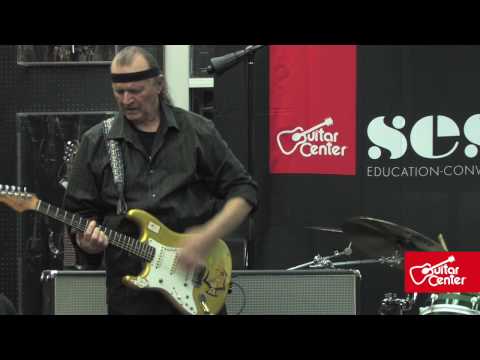
Dick Dale, often called the King of Surf Guitar, brought upside-down left-handed playing into one of the loudest and most aggressive corners of early rock guitar. His rapid-fire picking, heavy reverb, and Middle Eastern-influenced melodies helped define the surf rock sound of the early 1960s.
Dale was left-handed, but he did not follow the Jimi Hendrix route of flipping a guitar and then restringing it. Fender notes that Dale kept the strings in their original order, with the heaviest strings on the bottom from his point of view. That gave his playing a very different physical feel, especially when combined with his forceful picking hand and heavy string gauges.
His relationship with Fender is also a major part of the story. Dale pushed his gear extremely hard, which helped lead to louder, tougher amplifiers that could survive his stage volume. His sound was not just about technique, it was also about power, reverb, and an attack that made the guitar feel almost percussive.
Good tracks to start with include “Misirlou,” “Let’s Go Trippin’,” and “The Wedge.”
Malina Moye

Malina Moye brings upside-down left-handed guitar playing into a modern mix of blues, rock, funk, and soul. She is often seen with Strat-style guitars, including custom left-handed models that are still strung in reverse.
Moye started playing this way as a child. Her father gave her a right-handed guitar, but because she was naturally left-handed, she flipped it over and immediately felt more comfortable. Rather than correcting the setup, she kept going and developed her style around it.
Her playing has a strong rhythmic edge, which suits the funk and soul side of her music, but she can also lean into big blues-rock bends and high-gain lead work. Rather than treating the reversed setup as a gimmick, Moye has built it into a polished, modern guitar style that works across several genres.
Moye has also spoken about using a custom American-built Fender Stratocaster with a left-handed body, right-handed headstock, and reversed string layout, with the high E on top. That makes her a strong modern example of an upside-down left-handed guitarist whose setup is part of her broader musical identity.
Good tracks to start with include “K-yotic,” “Bad As I Wanna Be,” and “Enough.”
Bobby Womack

Bobby Womack is best known as a soul singer, songwriter, and hitmaker, but he was also an upside-down left-handed guitarist. Like several players in this list, his unusual setup came from necessity rather than design.
Growing up in a musical family, Womack learned on the guitars that were available to him. Instead of restringing a right-handed guitar, he simply flipped it over and made it work. That practical beginning became part of his musical identity.
Womack’s guitar playing was not about flashy lead runs or big blues-rock solos. His strength was rhythm, groove, and feel. His parts often sat deep in the pocket, supporting the song rather than fighting for attention, which suited the raw emotional pull of his voice and songwriting.
That approach also made him valuable beyond his own solo records. Before becoming a major artist in his own right, Womack worked as a guitarist and songwriter for other performers, bringing his distinctive touch to soul, R&B, gospel, and rock-influenced recordings.
Good tracks to start with include “Across 110th Street,” “That’s the Way I Feel About Cha,” and “Woman’s Gotta Have It.”
Jimmy Cliff

Jimmy Cliff is best known as one of reggae’s great voices, but he was also a left-handed guitarist often seen playing upside down. For many fans, his guitar was not the main focus in the way it might be with a blues or rock player, but it was still part of his identity as a performer and songwriter.
Cliff’s playing was built around feel, rhythm, and songcraft rather than technical display. That made sense for his music, where the guitar usually served the groove and supported the vocal instead of taking over the track.
His upside-down approach also fits neatly with the practical, self-taught spirit found in many of the players on this list. Rather than following a standard route, Cliff found a way of playing that worked for him and used it to help deliver songs that reached far beyond Jamaica.
As an artist, Cliff played a major role in bringing reggae to a global audience. His guitar work may be understated, but it sits inside some of the most important and widely loved songs in the genre.
Good tracks to start with include “Many Rivers to Cross,” “The Harder They Come,” and “You Can Get It If You Really Want.”
MonoNeon

MonoNeon is one of the most recognizable modern examples of an upside-down left-handed bassist. Known for his bright visual style, experimental funk, and off-kilter sense of groove, he has turned an unusual bass setup into a major part of his musical identity.
Unlike most players in this article, MonoNeon is primarily a bassist rather than a guitarist. He plays left-handed on an upside-down right-handed bass, bringing the same kind of reversed-string approach into the low-end world. That makes him an important name to include when talking about upside down left-handed bass players.
Related Article – Famous Left-Handed Bassists.
His style is hard to place in one box. There are clear links to funk, soul, gospel, hip-hop, and experimental music, but his playing often sounds like it is bending those influences into something stranger and more personal. His grooves can be tight and pocket-focused one moment, then lurch into unusual phrasing, slides, bends, and melodic runs the next.
Good tracks to start with include “Invisible,” “Hot Cheetos,” and “Supermane.”
More Upside-Down Left-Handed Guitarists and Bassists
The players above are some of the best-known examples, but there are plenty more upside-down left-handed guitarists and bassists worth mentioning.
Other examples include Gruff Rhys, Greta Brinkman, Dan Swanö, Cormac Battle, Seal, Buster Odeholm, Rusty Burns, Ed Harcourt, Hannah Joy, Bob Geldof, Chase Bryant, Kris Roe, and Amber Bain.
Why Do Some Left-Handed Guitarists Play Upside Down?
Most upside-down left-handed guitarists started that way for one simple reason: they learned on whatever guitar was available.
For many players, especially those who began as children, that usually meant a right-handed guitar owned by a family member, friend, school, or church. Rather than waiting for a left-handed model or restringing the instrument, they flipped it over and started playing.
By the time they realized their setup was unusual, it often felt too late to change. The chord shapes, picking patterns, and muscle memory were already in place, so they kept going and built their own style around it.
Is Playing Guitar Upside Down Harder?
Playing guitar upside down is not necessarily harder, but it is less straightforward at the beginning.
Most lessons, chord diagrams, tabs, and technique advice are written for standard guitar layouts. That means an upside-down left-handed player often has to translate things in their head, adapt fingerings, or ignore some of the usual rules altogether.
The upside is that this can lead to a more personal style. Many players on this list sound distinctive partly because they had to solve the instrument in their own way.
Upside Down vs Left-Handed Guitar: What’s the Difference?
A left-handed guitar is built for left-handed playing. The body shape, controls, nut, bridge, and string order are arranged so the guitar works like a mirror image of a standard right-handed model.
An upside-down guitar is usually a right-handed guitar turned over and played left-handed. Some players also use left-handed guitars strung in reverse, but the important difference is the string order.
Do Upside-Down Guitarists Use Different Chord Shapes?
The chords themselves are the same, but the way an upside-down guitarist fingers them can be different.
Because the string order is reversed, familiar chord shapes may not sit under the fingers in quite the same way. Some grips become more awkward, while others can feel surprisingly natural once the player gets used to the layout.
This is one reason upside-down left-handed players can be so interesting to watch. Even when they are playing familiar chords, their hands may approach them in a very different way.
FAQs About Guitarists Who Play Upside Down Left-Handed
Yes, but not in the same way as most players in this article. Jimi Hendrix famously played right-handed guitars flipped over left-handed, but he usually restrung them for a standard left-handed string order.
So while Hendrix did play an upside-down guitar physically, he was not generally playing with the strings upside down in the same sense as Albert King, Eric Gales, or Elizabeth Cotten.
Yes. Eric Gales plays left-handed with the guitar upside down and the strings reversed from a standard left-handed setup.
His upside-down style is a big part of what makes his playing so recognizable, especially his bends, vibrato, and fast blues-rock lead lines.
Reverse stringing is when the strings are arranged in the opposite order from a standard guitar setup.
Yes. You can learn guitar upside down left-handed, and plenty of great players have done exactly that.
The main challenge is that most beginner resources are written for standard guitar setups, so you may need to adapt chord diagrams, fingerings, and technique advice as you go. It can be less convenient, but it is definitely possible.
If you are just starting out, a regular left-handed guitar will usually be easier to learn on. But if upside-down playing already feels natural to you, there is no rule saying you have to change.

