
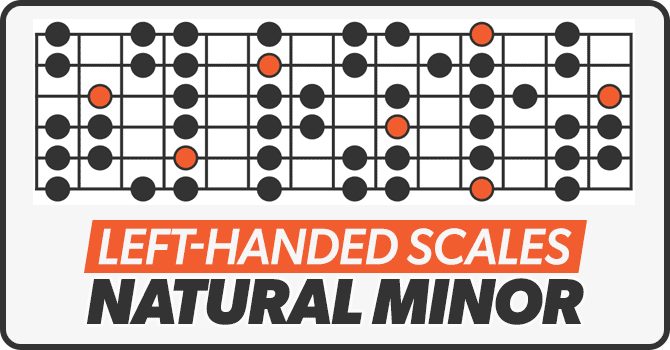
The natural minor scale is one of the most useful scales you can learn on guitar. It has a darker, more emotional sound and is commonly used in rock, metal, blues, pop, classical music, and many other styles.
Also known as the Aeolian mode, the natural minor scale is defined by its flattened 3rd, 6th, and 7th notes, which give it a darker and more somber sound than the major scale.
Most guitar scale diagrams are designed for right-handed players, which can make learning new patterns awkward for lefties. In this guide, you will find clear left handed natural minor scale charts covering five positions of the fretboard, plus diagrams for every key.
You can also download the complete set of charts as a free printable PDF.
You may also find my guides to the minor pentatonic scale, major pentatonic scale, blues scale, and major scale useful.
What Is the Natural Minor Scale?
The natural minor scale uses the following formula: 1, 2, b3, 4, 5, b6, b7
Its interval pattern is: Whole, Half, Whole, Whole, Half, Whole, Whole
The flattened 3rd, 6th, and 7th notes give the scale its characteristic minor sound.
The natural minor scale and Aeolian mode contain the same notes and use the same interval pattern. Natural minor is the term you will usually hear when discussing minor keys, while Aeolian is more common when studying the modes of the major scale.
For example, A Natural Minor and A Aeolian both contain:
A, B, C, D, E, F, and G
5 Natural Minor Scale Positions for Lefties
One of the easiest ways to learn the natural minor scale is to divide the fretboard into five smaller positions.
Each shape covers a manageable area of the neck and overlaps with the patterns beside it. Once you have learned all five positions, you can connect them to play the scale across the entire fretboard.
The diagrams below use the A natural minor scale.
The highlighted orange circles show the A root notes. These notes identify the key of the scale and provide useful starting and finishing points when creating melodies.
Position 1
Position 1 is a useful place to begin when learning the natural minor scale.
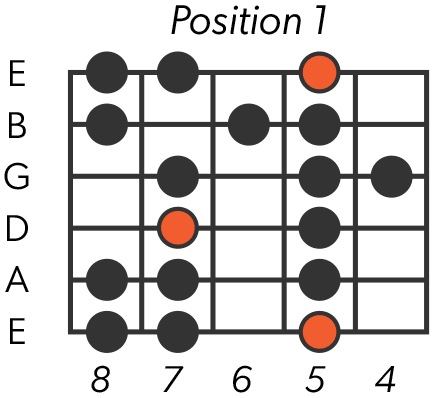
Pay close attention to the highlighted root notes. Try starting and ending short phrases on these notes so you can hear how they create a resolved sound.
Position 2
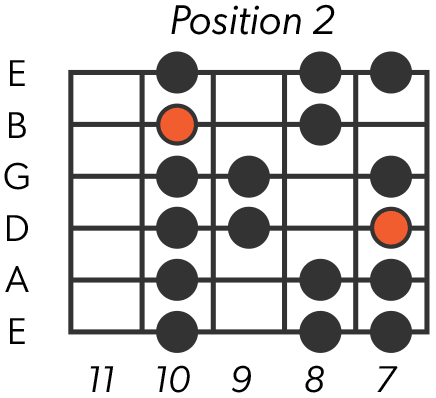
Practice this pattern by itself before combining it with Position 1.
The two shapes share several notes, making it easy to move between them once you become familiar with the overlap.
Position 3
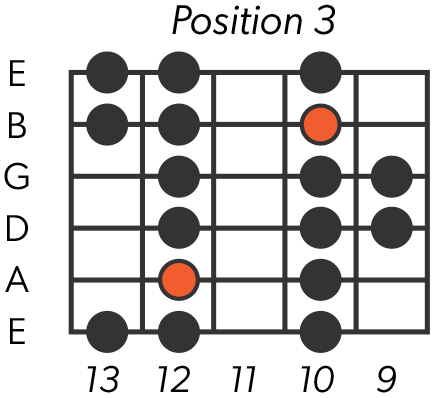
As with the previous positions, take time to identify the root notes rather than memorizing only the shape.
Position 4
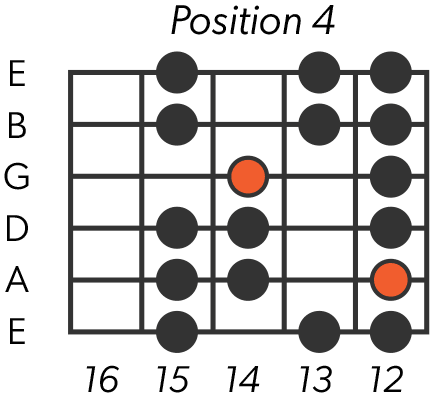
Compare this pattern with Positions 3 and 5 and look for the notes they share.
These overlapping notes will help you move between positions without making large or awkward jumps.
Position 5
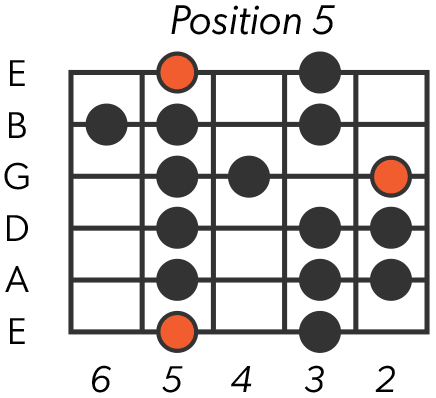
Position 5 completes the five-position natural minor scale system, connecting back with position 1.
How to Connect the 5 Natural Minor Scale Positions
All five natural minor scale positions connect across the guitar neck. Each pattern overlaps with the positions beside it, giving you several notes that can be used as transition points.
The diagram below shows how the five positions of the A natural minor scale fit together.
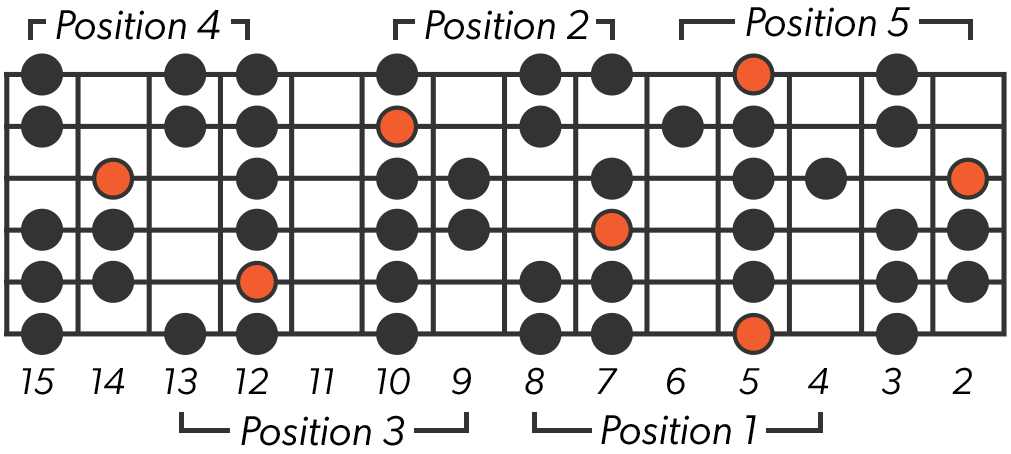
Begin by connecting two neighboring positions at a time. For example, play through Position 1, move into Position 2, and then return to the first shape.
Repeat this process with Positions 2 and 3, Positions 3 and 4, and Positions 4 and 5.
Once these smaller transitions feel comfortable, begin combining three or more positions. This will help you move more freely across the neck when improvising.
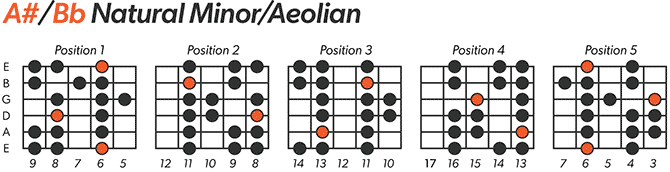
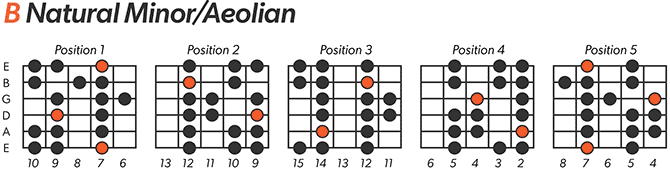
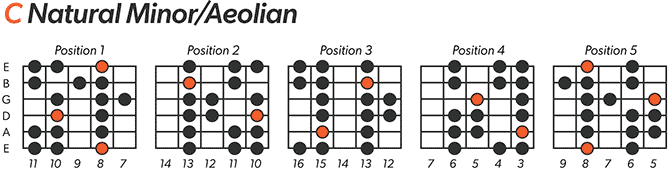
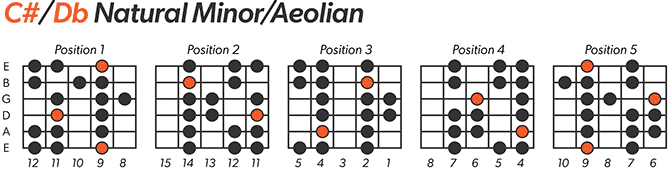
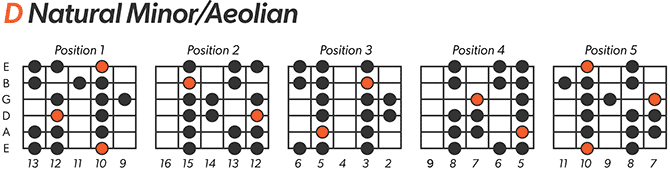
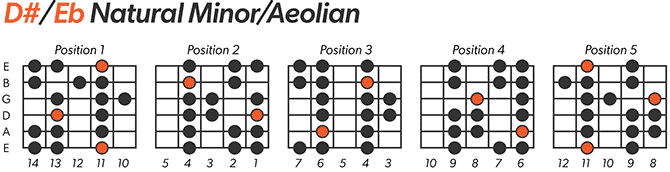
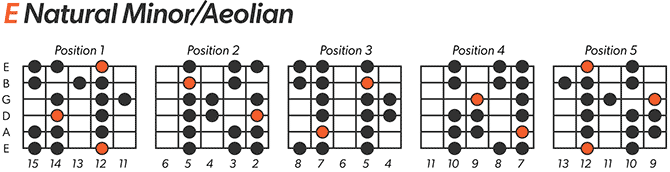
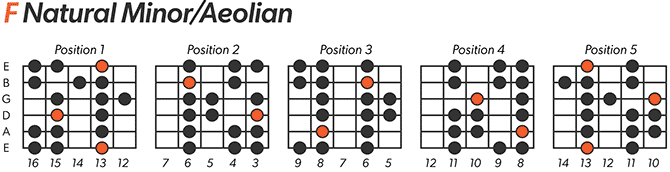
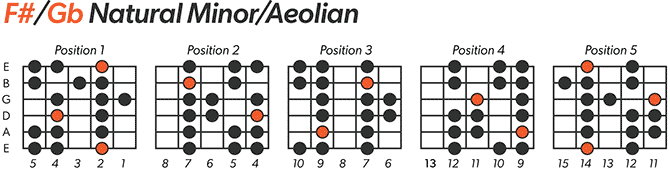
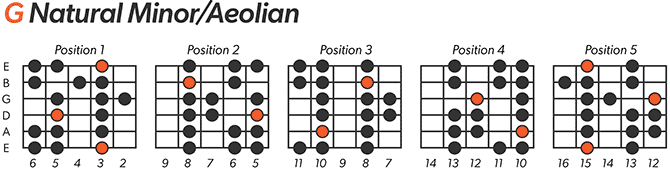
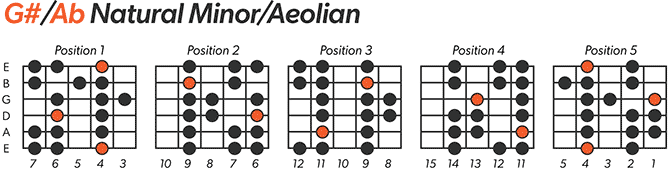
All Left Handed Natural Minor Scale Charts
Below you will find left handed natural minor scale charts for every key.
You can also download the full set of charts as a free printable PDF. Save the file to your phone or tablet, or print it for quick reference while practicing.
Download and Print the Scales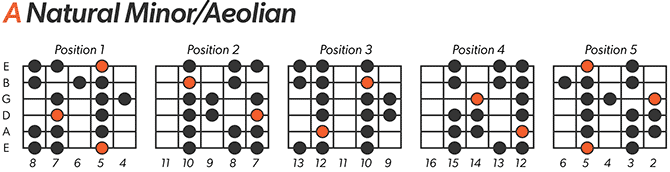
Natural Minor Scale vs Minor Pentatonic Scale
The natural minor scale is closely related to the minor pentatonic scale, but it contains two additional notes.
The A natural minor scale contains seven notes: A, B, C, D, E, F, G
The A minor pentatonic scale contains five notes: A, C, D, E, G
The minor pentatonic scale removes the 2nd and flattened 6th notes. In the key of A minor, these notes are B and F.
Because it contains fewer notes, the minor pentatonic scale is often easier for beginners to memorize and use while improvising.
The natural minor scale offers more melodic options, but the additional notes can create more tension over certain chords.
If you already know the left handed minor pentatonic scale positions, many parts of the natural minor patterns will look familiar.
Practice With Jam Tracks
A good way to practice the natural minor scale is to use a backing track in the same key.
Start with an A minor track when using the diagrams in this guide. Play through each position slowly before experimenting with short phrases and moving between different areas of the fretboard.
Try to avoid running directly up and down the scale every time. Repeating notes, changing direction, using bends, and leaving space between phrases will make your playing sound more musical.
Head over to the guitar jam tracks section to find backing tracks in a wide range of keys and styles.
More Left Handed Guitar Lessons
You will find plenty more left handed guitar lessons on the site, including scale charts, chord guides, beginner lessons, and useful practice resources created specifically for left-handed players.

