

Finding the best beginner left-handed bass guitar can be surprisingly difficult. Many manufacturers produce far fewer lefty bass models, which means beginners often have limited options.
In this guide, I have rounded up the best beginner left-handed bass guitars currently available, focusing on affordable models that are easy to play and widely available.
Whether you want a short-scale bass, a versatile PJ setup, or a simple starter instrument, these left-handed basses are excellent choices for new players.
Shorter left handed people or those with smaller hands may also like to check out my guide to the best ¾ sized left handed guitars and basses.
Quick Comparison – Best Beginner Left-Handed Bass Guitars
| Model | Best For | Why I Recommend It |
|---|---|---|
| Harley Benton Basses | Best Budget Options | Extremely affordable and great value starter instruments |
| Rogue LX200BL | Cheapest Beginner Bass | One of the most affordable left handed basses available |
| Ibanez Mikro GSRM20L | Smaller Hands | Shorter scale makes it easier for beginners to play |
| Ibanez GSR200BL | Best Value Overall | Excellent balance of quality, tone and affordability |
| Squier Classic Vibe 70s Jazz | Best Vintage Style Bass | Vintage style tone with excellent build quality |
| Ibanez SR305EBL | Best 5 String Bass | Perfect for players who want extended range |
Disclosure: If you decide to purchase a guitar using the links in this article, I will earn a small commission at no additional cost to you. Thank you!
How to Choose a Beginner Left Handed Bass Guitar
Choosing your first left-handed bass guitar can feel confusing, especially with fewer models available compared to right-handed instruments. The good news is that beginners do not need anything overly complicated or expensive to get started.
The most important things to consider are comfort, build quality, and versatility. Many beginners prefer a standard 4-string bass because it is easier to learn on and widely used across most styles of music. Some players with smaller hands may also find short-scale basses more comfortable to play.
Pickup configuration and electronics matter less when you are starting out. What matters most is finding a bass that feels comfortable, stays in tune, and inspires you to practice. All of the left-handed bass guitars in this guide are excellent beginner-friendly options that offer great value for the price.
Harley Benton Left-Handed Bass Guitars

Browse The Full Range At:
Players looking for the best cheap left handed bass guitars need look no further than the incredible range on offer from Harley Benton.
Harley Benton has always offered a huge variety of left-handed basses and guitars, with instruments starting from under $100. These are ideal for new players looking to dip their toes into the world of bass without splashing a lot of cash.
The image above shows just a small sample of what is available from the budget brand. There are too many to recommend just one model, so check out the link above to see the full selection. All of the various models are inspired by iconic bass designs, so there should be a choice for all tastes here!
More experienced players after a cheap left-handed bass guitar to use as a backup instrument will also find the Harley Bentons to be an attractive choice. I recently picked up one of their Les Paul-style models and was blown away at the quality offered for such little money.
As well as the more beginner-friendly 4-string options, the brand also offers plenty of left-handed 5-string basses for those looking for additional range.
Harley Benton basses are available individually if you would prefer to piece together your own kit. However, for those looking to get into the instrument as quickly as possible, Harley Benton also offers left-handed bass starter package options. These are bundled with everything you need to get started, including an amp, tuner, gig bag, and more!
What I Like/Dislike About Harley Benton Basses
Like:
- Buy individually, or as a complete starter package
- Good quality and features for a low price
- Designs based on iconic basses
- Lightweight construction
Dislike:
- Brand snobs may not approve.
All in all, I can recommend these Harley Benton basses as my top choices for the best cheap left handed bass options. As a beginner southpaw bassist, you will struggle to find anything comparable for similar money.
Browse The Full Range At:
Rogue LX200BL Lefty Bass
Available Now At:
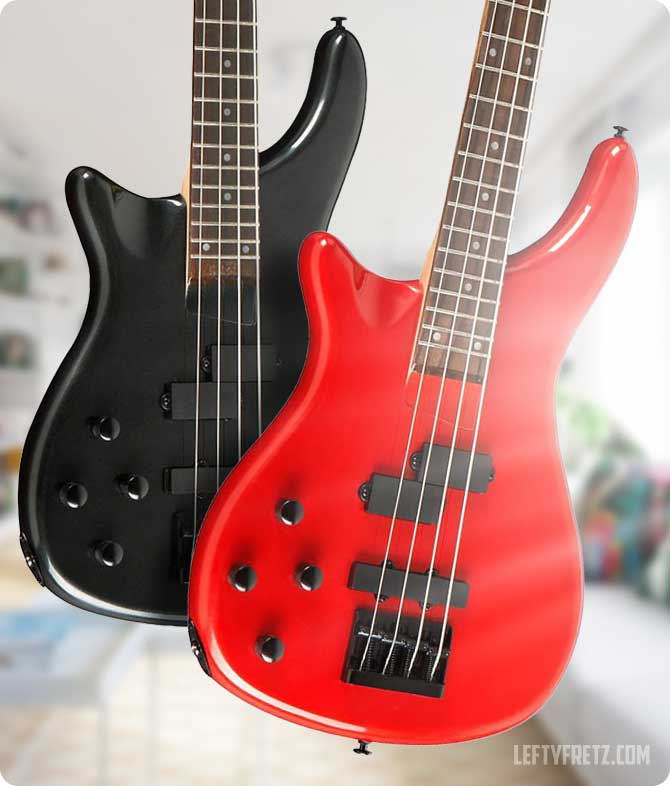
The Rogue LX200BL is a great alternative budget model for those outside of Europe who might not have quite as easy access to Harley Benton. In this case, the LX200BL is sold exclusively through Guitar Center USA.
The bass features a lightweight basswood body and a comfortable maple neck with a standard 34-inch scale length. The neck profile is fairly slim and easy to play, which helps new players develop good technique without fighting the instrument.
It is currently available in a choice of 3 colors – red, black, and blue.
The Rogue bass uses a PJ pickup configuration, with a split coil P-style pickup in the neck position and a J-style single coil at the bridge. I like this setup for beginners because it offers more tonal flexibility than a single-pickup bass. The P pickup gives you that classic warm and punchy low end, while the bridge pickup can add extra clarity and bite when needed.
The control layout is still very beginner-friendly, with simple volume and tone controls that let you blend the pickups and shape your sound without making things complicated.
What I Like/Dislike About The Rogue LX200BL
Like:
- One of the most affordable left-handed basses currently available
- Simple control layout that is great for beginners
- Lightweight body that is comfortable for practice sessions
- Classic P bass style tone that works for many genres
Dislike:
- Stock strings are fairly cheap and worth upgrading
- Only available through Guitar Center
At this price point, I am not expecting premium components or fancy features. What matters more is that the bass is comfortable to play and gets the fundamentals right. For someone who simply wants an inexpensive left-handed bass to learn on, the LX200BL does exactly what it needs to do.
Available Now At:
Ibanez miKro GSRM20L Short Scale Left Handed Bass
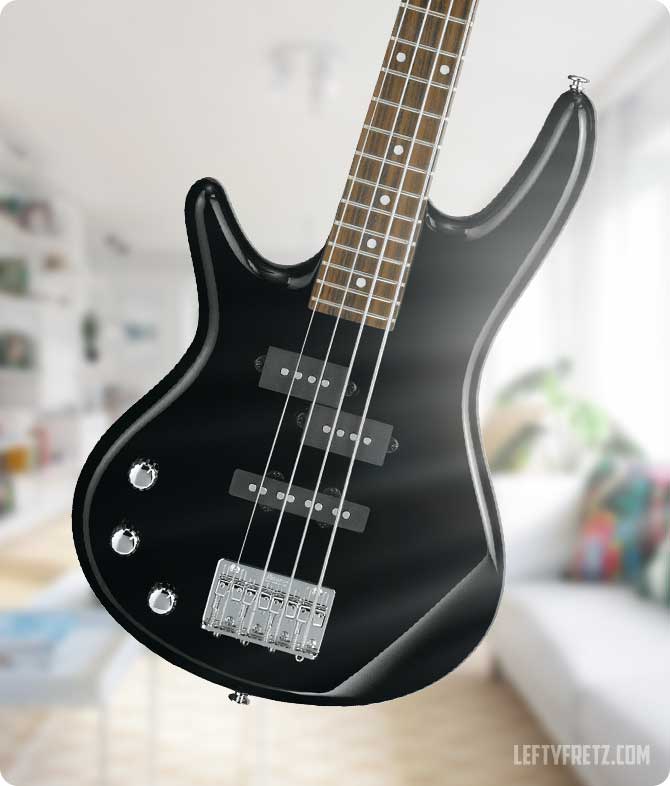
I included the Ibanez miKro GSRM20L on this list because it is one of the best options for beginners who want a bass that feels smaller and easier to play. A full-size 34-inch scale bass can feel intimidating for some new players, especially younger musicians or those with smaller hands. The miKro is designed to solve that problem with a much more compact layout.
The main difference is the shorter 28.6-inch scale length. Because the frets are closer together, it makes stretches easier and generally feels more comfortable when you are learning. Despite the smaller size, it still feels like a proper electric bass and delivers a solid low end.
Like many Ibanez basses, the miKro uses a PJ pickup configuration with a P-style split coil in the neck and a J-style single coil at the bridge. I like this setup because it gives beginners a nice range of tones to experiment with. The neck pickup delivers a warm, punchy sound while the bridge pickup adds extra clarity and definition when blended in.
What I Like/Dislike About The Rogue LX200BL
Like:
- Short 28.6-inch scale that is ideal for smaller hands
- Very comfortable and lightweight design
- Versatile PJ pickup configuration
Dislike:
- Short scale may feel cramped for players used to full-size basses
- Slightly less low-end compared to a full-scale bass
The rest of the design is simple and beginner-friendly. It has a lightweight body, a slim maple neck, and straightforward controls with two volume knobs and a master tone. Overall, it is a very comfortable bass that makes learning feel less intimidating.
Ibanez GSR200BL Left Handed Bass

The trusty Ibanez GSR200BL was actually the first bass that I picked up, probably 20 years ago. Although you guys are lucky because back then it was only available in a boring gloss black color, whereas now it comes in a gorgeous satin walnut finish.
It is an ideal choice for beginners thanks to its compact and lightweight nyatoh body and slim maple neck profile. Plus, the inclusion of both precision and jazz bass style pickups makes the GSR200BL a really versatile instrument, well-suited to a wide variety of musical styles.
Of course, these features also make it a perfect bass for guitarists wanting to dip their toes into the world of bass. The guitar is solidly made, gives you plenty of punchy, fat tone, and is currently the most affordable left-handed 4-string bass from a big-name brand.
Other key features include a 22-fret jatoba fingerboard, an Ibanez B10 bridge for tons of juicy sustain, a master tone pot, plus separate volume knobs for each pickup. Ibanez has also included their Phat II EQ control, which provides an active bass boost for additional low-end power.
It’s worth noting that a slight downside to having the Phat II active boost circuit is that it requires a 9V battery to operate. Without the battery (or if you let it go flat), the bass won’t make much sound at all. If you opt for this bass and notice that it sounds lifeless and muddy, check the battery before you send it back!
Here’s a quick video that will give some sound samples from the GSR200BL, plus a demonstration of the awesome Phat II EQ. Note that the left-handed version is not available in this black finish.

There really aren’t many disadvantages to this bass considering its low price point. However, it would be nice if it came with a gig bag.
Key Features:
- Body: Nyatoh (Similar To Mahogany)
- Neck: Maple w/ 22 Fret Jatoba Fingerboard
- Pickups: Ibanez Dynamix P & J Style
- Controls: 2 Volume, Master Tone, Active Bass Boost
- Gig Bag: No
- Accessories: None
What I Like/Dislike About The Ibanez GSR200BL
Like:
- Ibanez quality and features for a low price.
- Huge range of tones.
- Active bass boost for additional power.
- Lightweight and comfortable.
Dislike:
- No gig bag included.
- 9V battery required.
- The style may not be for everyone.
Overall, I would rate the trusty Ibanez GSR200BL as being one of the best beginner left-handed bass guitars. They’re super versatile, look fantastic, are comfortable to hold, and you get a big brand name on your headstock for not a lot of money.
Squier Classic Vibe 70s Jazz Bass Left Handed

Here at LeftyFretz, I keep no secrets about my love for the Squier Classic Vibe series. For the money, this Fender-designed collection is tough to beat.
This range forms Squier’s flagship offering, and as such, these are instruments that can easily go toe to toe with some of their more expensive Fender cousins.
The Squier Classic Vibe 70s Left-Handed Jazz Bass is modeled after a 1970s-era Fender Jazz Bass. It offers a comfortable offset body design and is an incredibly versatile instrument with a huge range of punchy tones available.
It features a lightweight poplar body and maple neck, and adds a 20-fret maple fingerboard to help brighten up the tone. The chunky block fretboard inlays mesh well with the gloss black body for an overall classy look.
The neck is a slim, beginner-friendly profile that tapers down to just 1.5 inches wide at the nut. It is ideal for unleashing fast and technical basslines and is also perfect for players with smaller hands.
The Classic Vibe features two Fender-designed alnico single-coil pickups that serve up bags of the articulate and punchy tones that Jazz basses are famed for. Separate volume controls for each pickup let you precisely dial in a plethora of different sounds.
You can hear this bass in action in the video below. Note that the left-handed model is not currently available in this sunburst finish.

What Is A Jazz Bass Good For?
Compared to the powerful grunt of a P bass, the Jazz bass offers more in the middle and treble frequencies. It is generally thought of as the more versatile model thanks to its dual single-coil pickups and separate volume controls.
It tends to be favored by fingerstyle or slap players, and is popular within genres such as jazz, funk, fusion, and prog metal. In saying that, the Jazz bass is known for its versatility and is widely used in virtually every genre of music.
Key Features:
- Body: Poplar
- Neck: Maple w/ 20 Fret Maple Fingerboard
- Pickups: 2 Fender Designed Alnico Single-Coil Pickups
- Controls: 2 Volume Controls, Master Tone
- Gig Bag: No
- Accessories: None
What I Like/Dislike About The Squier CV 70s Jazz Bass
Like:
- Fender quality for a fraction of the price
- Incredibly versatile.
- Slim, fast neck.
- 2-year warranty included.
- Also a great option for intermediate players, or more advanced bassists looking for a solid backup instrument.
Dislike:
- No gig bag included.
- Only one color is available.
- Single-coil pickup hum.
An absolutely fantastic bass – I still actually use one as my main bass to this day! Brilliant for beginners, but also solid enough to be used by gigging musicians – what’s not to love?
Ibanez SR305EBL 5 String Left Handed Bass

The Ibanez SR305EBL is an excellent choice for bass players looking to expand their range with a 5-string instrument, particularly those who play heavier genres like metal.
The addition of a low B string gives bassists access to deeper, growling lows that are perfect for metal’s heavy riffs and aggressive soundscapes. The additional string not only adds more tonal options but also allows for more complex riffing and chordal playing.
This bass is equipped with Ibanez PowerSpan pickups, which provide a strong, punchy sound with clarity and articulation. They excel at cutting through dense guitar mixes, making sure your low end stays present, even in the most distorted metal mix.
Additionally, the 3-band EQ and Power Tap switch give you flexible control over your tone, allowing you to toggle between humbucking and single-coil modes. Perfect for dialing in that sharp, aggressive metal tone or a smoother, more rounded sound for other genres.
Another key advantage of the Ibanez SR305EBL is its lightweight body and slim neck profile, which make it comfortable to play during long performances or extended practice sessions.
Key Features:
- Body: Nyatoh
- Neck: 5-Piece Maple/Walnut w/ 20 Fret Jatoba Fingerboard
- Pickups: Ibanez PowerSpan Dual Coil
- Controls: Ibanez Custom Electronics 3-band EQ w/ 3-Way Power Tap Switch
- Gig Bag: No
- Accessories: None
What I Like/Dislike About The Fender Player Basses
Like:
- Affordable 5-String From A Well-Respected Brand
- Lightweight Nyatoh Body
- Thin & Fast Ibanez SR5 Neck Profile
Dislike:
- No gig bag included
- No color choices
For metal bassists who need a bass capable of delivering low-end power and versatile tones, the Ibanez SR305EBL is an excellent choice.
Final Thoughts
If you are looking for the best beginner left-handed bass guitar, the most important thing is choosing an instrument that feels comfortable and inspires you to practice. While left-handed basses are less common than right-handed models, there are still several excellent beginner-friendly options available today.
For most players, a versatile and affordable model like the Ibanez GSR200B is a great place to start. However, shorter scale instruments such as the Ibanez miKro GSRM20L can be a better fit for players with smaller hands, while options like the Squier Classic Vibe 70s Jazz Bass offer more traditional tone and styling.
Any of the left-handed bass guitars in this guide can serve as a great first instrument, so the best choice ultimately comes down to your budget, preferences, and playing style.
Bass Guitar Buying Advice
Is it Harder to Learn Bass Left-Handed?
No. Learning bass left-handed is no more difficult than learning right-handed. The main challenge is simply that fewer left-handed instruments are available. Once you have a proper left-handed bass guitar, the learning process is exactly the same. Read my post ‘should i learn left or right-handed?‘ for further thoughts.
Why are Left Handed Bass Guitars Harder to Find?
Most guitar manufacturers produce far fewer left-handed instruments because the majority of players are right-handed. As a result, the selection of lefty basses is usually smaller. Read why are left handed guitars more expensive for a deeper insight.
Should I Get a 4 or 5 String Bass?
Most beginners start with a 4-string bass because it is simpler and widely used across most genres. However, a 5-string bass can still be a good choice if you want access to lower notes or plan to play styles like metal or modern rock.
Look at what your favorite players use to get a good idea of which style is best for you. You can also check out my guide to the different types of bass guitar for more in-depth information!
Short Scale vs Long Scale Bass
Almost all of the basses I have recommended above have a standard 34” scale length (read my guitar scale length guide for more info). This is the most common bass scale length and is the best option for most.
A longer scale length bass will have higher string tension, leading to a more defined and articulate sound.
Short-scale basses generally have a scale length of 31” or less. The main advantage of these instruments is their smaller physical size, plus a shorter distance between frets. This makes them ideal for smaller players or for those with smaller hands.
The downsides are that you’ll lose some of that crisp definition, and the strings will have a looser feel due to the lower tension.
Is Active Or Passive Bass Better?
In a nutshell, you can think of an active bass as being powered, and a passive bass as being…not powered. An active bass system is generally run by a 9V battery.
But which to opt for? The best option will depend on your particular situation, so there isn’t a solid answer to this question!
The main advantage of an active bass is that it will generally offer more options for sculpting your tone. The disadvantage is that if you allow the battery to go flat, your tone will suffer.
As a beginner, I would personally stick with a passive bass (almost all of the suggestions above are passive), as it keeps things a little simpler for you. But since the only real difference is remembering to keep a charged battery, go for it if you think you will benefit!
How Much Should I Spend On A Bass?
I always suggest that new players should spend as much as they can comfortably afford. As they say, buy cheap, buy twice! Remember to factor in the cost of an amp and any other accessories you might need.
It would be incredible to grab a Fender Custom Shop bass as your first instrument, but that’s probably not the best idea for most! The majority of basses under $100 are essentially toys, so avoid those like the plague and instead stick with one of the options I’ve suggested above.
You won’t go wrong with any of the basses listed here!
Can I Use A Guitar Amp With A Bass?
If you are a guitarist looking to try out bass, then you may be wondering if you can save a few bucks and just use your regular amp.
While the answer is that technically, yes, you can. However, you will probably want to pick up a bona fide bass amp. A guitar amp is not specifically designed to handle the lower frequencies produced by a bass, and you may end up actually damaging your speaker!
Check out the links at the bottom of this page to find my recommendations for quality bass amps.
Should I Get My Bass Setup?
It is generally a good idea to have a new instrument setup at your local guitar store. This process involves making a few key adjustments to make sure that your bass is in tip-top playing condition.
New players might make things unnecessarily hard on themselves by persevering with an instrument that is difficult to play. A mere 15 minutes in the hands of an experienced guitar tech could be all that’s needed to make that bass play buttery smooth!
Find out more in my complete guide to guitar setups.
Next Up – Amps!
So, now that you hopefully have selected your first bass, you’ll probably want to check out part six below to pick out an amp to go with it.
Still have questions? Feel free to send me an email, and I’ll get back to you as soon as possible! You’ll find a link to my contact form in the footer below.
Part One : Tips Before You Buy
Part Two : Beginner Electric Guitars
Part Three : Beginner Acoustic Guitars
Part Four : Beginner Bass Guitars
Part Five : Beginner Classical Guitars
Part Six : Amps
Part Seven : Effects
Part Eight : Accessories
Part Nine : Lessons

