
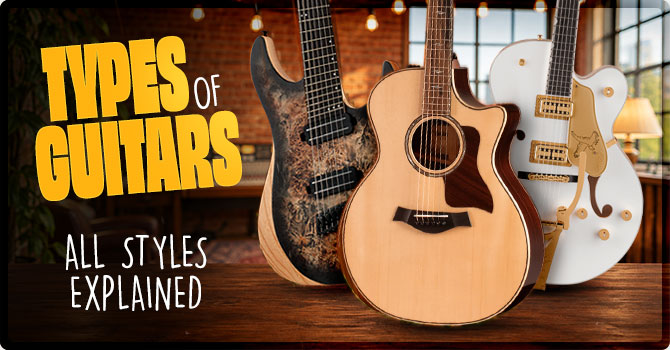
From acoustic and classical to electric, baritone, and resonator, there are far more types of guitars out there than most people realize. Each one has its own sound, feel, and favorite genres, and choosing the right one can make a big difference to how much you enjoy playing.
This guide breaks down 15 different types of guitars: what each one sounds like, what it’s best for, and the pros and cons to consider before you buy. Whether you’re shopping for your first guitar or just wondering what that strange-looking instrument hanging on the music store wall is, you’ll find it here.
I’ve played plenty of the guitars on this list over the years, from classicals and acoustics to semi-hollows and 8-strings, so I’ll share my own take along the way.
Jump to:
- Types of guitars at a glance
- Types of acoustic guitars
- Types of electric guitars
- Other types of guitars
Types of Guitars at a Glance
Here’s a quick comparison of all 15 types of guitars in this guide. Tap any type to jump to its full details.
| Type of Guitar | Best For | Sound |
|---|---|---|
| Steel-string acoustic | Folk, pop, rock, country, singer-songwriter | Bright, full, and loud unplugged |
| Acoustic-electric | Playing acoustic music live or recording | Like an acoustic, but plugs into an amp or PA |
| Classical | Classical, flamenco, Latin, fingerstyle | Warm, soft, and mellow |
| 12-string | Folk, rock, big shimmering strums | Rich and jangly, almost like a chorus effect |
| Resonator | Blues, bluegrass, slide | Loud, metallic, and twangy |
| Solid-body electric | Rock, metal, blues, pop, and almost anything else | Hugely versatile, shaped by pickups, amp, and effects |
| Semi-hollow | Blues, jazz, rock, indie | Warm and airy, with plenty of sustain |
| Hollow-body and archtop | Jazz, rockabilly, blues | Warm, round, and woody |
| Extended-range | Metal, djent, progressive | Deep and heavy low end |
| Baritone | Heavy rock, metal, surf, ambient | Lower and darker than a standard guitar |
| Multiscale | Metal, progressive | Tight, clear low end |
| Bass | Holding down the low end | Deep and punchy |
| Lap steel & pedal steel | Country, Hawaiian, blues | Smooth, gliding, and vocal-like |
| Travel and short-scale | Traveling, kids, smaller hands | Lighter and quieter than full size |
| Unusual guitars | Double-necks, harp guitars, headless designs | Varies |
Types of Acoustic Guitars
Acoustic guitars make their sound naturally, without needing any electronics. When you play, the strings’ vibrations pass into the body, which amplifies them and projects the sound out into the room. You don’t need an amp to hear them, although some, like acoustic-electrics, can plug in when you need more volume.
1. Steel-String Acoustic Guitars: The All-Rounder
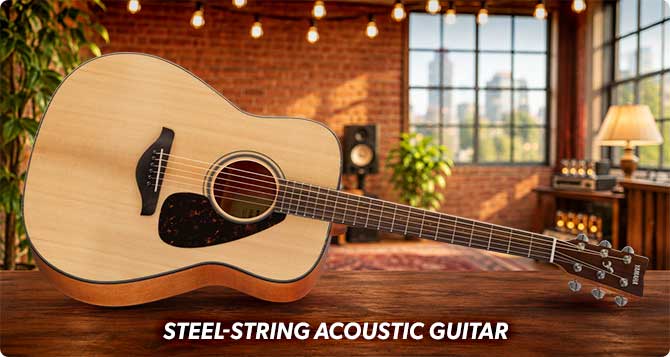
The steel-string acoustic guitar is what most people picture when they hear the word “guitar.” It’s loud enough to fill a room on its own, easy to grab and play, and works for almost any style you can strum or pick.
Steel strings give it a bright, full sound with plenty of sparkle. That makes it the go-to guitar for folk, pop, country, acoustic rock, and singer-songwriters.
Acoustic guitars come in several body shapes, and the size has a big effect on the sound:
- Dreadnought: The most common shape. Big, bold, and bassy, and great for strumming.
- Concert and auditorium: Smaller and more comfortable, with a balanced tone that suits fingerpicking.
- Jumbo: The biggest and loudest, with a huge low end.
- Parlor: Small and lightweight, with a sweet, vintage sound.
The main downside is that steel strings are tougher on your fingertips than nylon, so expect a few sore weeks when you’re starting out. Larger bodies can also feel bulky if you’re on the smaller side, which is where a concert or parlor shape comes in.
Best for: Strumming, fingerpicking, songwriting, and playing anywhere without an amp.
Famous steel-string acoustic players include Tommy Emmanuel, James Taylor, Joni Mitchell, Neil Young, and Ed Sheeran.
Playing left-handed? Check out my guide to the best left-handed acoustic guitars for beginners.
2. Acoustic-Electric Guitars: Acoustic Sound, Ready to Plug In
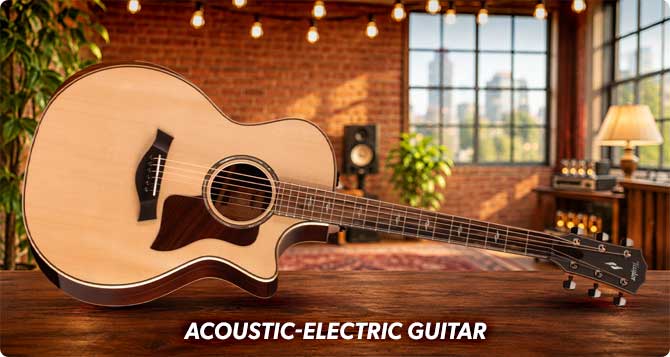
An acoustic-electric guitar (also called an electro-acoustic) is an acoustic guitar with a pickup and preamp built in. Unplugged, it sounds just like a regular acoustic. Plug it into an acoustic amp, PA system, or audio interface, and you can play to a crowd or record without setting up a microphone.
The pickup usually sits under the saddle or inside the sound hole, and some guitars blend it with a small internal mic. The onboard preamp boosts the signal, much like a preamp pedal, and usually adds volume and EQ controls on the side of the body. Many also have a built-in tuner, which is handy on stage.
You’ll often see acoustic-electrics with a cutaway, a scoop in the body near the neck that makes the higher frets easier to reach. Nylon-string classical guitars come in acoustic-electric versions too.
The downsides are a slightly higher price than an equivalent acoustic, and a battery to keep an eye on. Pickups on cheaper models can also sound a little thin or harsh when plugged in, so it’s worth trying one through an amp before you buy if playing live is the plan.
Best for: Gigging, open mics, church and worship bands, and recording acoustic parts easily.
3. Classical Guitars: Nylon Strings and a Mellow Tone
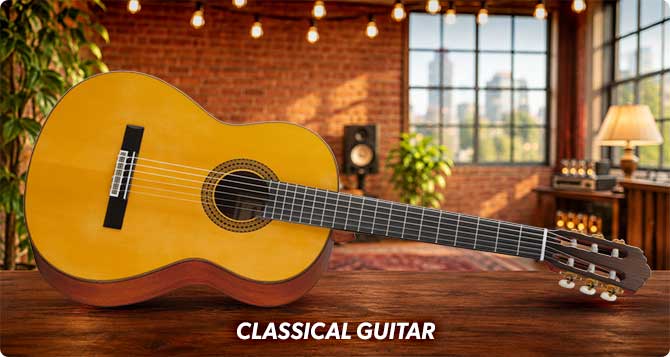
A classical guitar uses nylon strings instead of steel, which gives it a warm, soft, mellow sound. It’s the guitar of classical music, but you’ll also hear it in flamenco, bossa nova, Latin, and fingerstyle playing.
Classical guitars look a little different from steel-string acoustics. The neck is wider and flatter, usually around 2 inches at the nut, which gives your fingers more room for fingerpicking. They also tend to have a slotted headstock, a smaller body, and a neck that joins the body at the 12th fret rather than the 14th.
Nylon strings are much easier on your fingertips than steel, and classical guitars are often among the most affordable options. They also come in smaller sizes, which makes them a popular choice for kids.
On the other hand, the wide neck can feel awkward for chord shapes if you’re used to an electric. And don’t try putting steel strings on a classical guitar. It isn’t built for the extra tension, and you could damage the neck or pull the bridge off.
Flamenco guitars are a close cousin. They’re typically lighter, with lower string action and a brighter, punchier sound, and most have a protective tap plate (called a golpeador) to handle the percussive techniques flamenco is known for.
Best for: Classical, flamenco, Latin, fingerstyle, and anyone who wants a softer feel under their fingers.
Famous classical and nylon-string players include Andres Segovia, John Williams, Paco de Lucia, Julian Bream, and Willie Nelson, who has played the same battered nylon-string Martin, nicknamed “Trigger,” for decades.
Lefties, see my guide to the best left-handed classical guitars for beginners.
4. 12-String Guitars: Big, Shimmering Strums
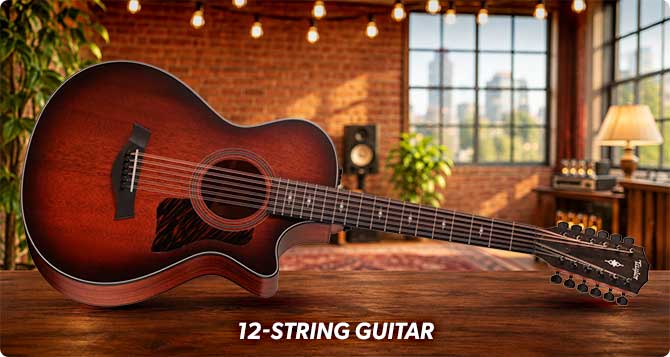
A 12-string guitar has six pairs of strings instead of six single strings. You play it just like a regular guitar, fretting and strumming each pair as if it were one string, but the result is a much bigger, richer sound.
The secret is in how the pairs are tuned. The lower four pairs combine a standard string with a thinner one tuned an octave higher, while the top two pairs are tuned to the same note. Together, they create a shimmering, jangly sound with a natural chorus effect that a 6-string can’t match.
12-strings are mostly acoustic, and they’re a favorite for folk and classic rock strumming. Electric 12-strings exist too, and they were behind a lot of the jangly 1960s sound.
The catch is that they take more effort to play. Pressing two strings at once needs more finger strength, the neck is a little wider, and bends and fast lead lines are tricky. You’ll also have twice as many strings to tune and change. Many players tune theirs down a step or two to ease the string tension.
Best for: Strumming, folk, classic rock, and adding a huge, full sound to a recording.
Famous 12-string players include Lead Belly, Pete Seeger, Roger McGuinn, George Harrison, and Jimmy Page.
Lefties, take a look at my guide to left-handed 12-string acoustic guitars.
5. Resonator Guitars: Loud, Metallic, and Made for Slide
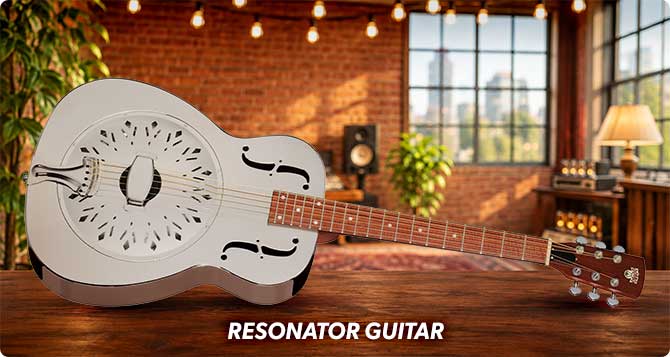
A resonator guitar gets its sound from one or more spun metal cones inside the body, rather than relying on a wooden top. The strings vibrate the cone, which acts like a speaker and throws the sound out much louder than a normal acoustic.
Resonators were invented in the late 1920s to help guitarists be heard over loud bands, before electric guitars came along. Their bodies are made from metal or wood, and they have a bright, punchy, metallic sound with plenty of twang.
There are three main designs:
- Single-cone: One large cone, with a strong, cutting sound. A favorite for blues.
- Tricone: Three smaller cones, with a smoother, sweeter tone and longer sustain.
- Spider bridge: One cone with a spider-shaped bridge on top, often sold under the Dobro name. This design is the classic sound of bluegrass.
Resonators also come with two neck styles. Round necks are played like a regular guitar, with or without a slide. Square necks are played flat on your lap with a steel bar, similar to a lap steel.
The trade-offs are that metal-bodied resonators are heavy, and that unique sound isn’t the most versatile. They also tend to cost more than a standard acoustic of similar quality.
Best for: Delta blues, bluegrass, country, and slide guitar.
Famous resonator players include Son House, Bukka White, Tampa Red, Jerry Douglas, and Bob Brozman.
Types of Electric Guitars
Electric guitars use magnetic pickups to turn the strings’ vibrations into an electrical signal, which is sent to an amplifier. Unplugged, they’re much quieter than an acoustic, since the body isn’t designed to project sound. Plugged in, you can shape your sound with your amp, pickups, and effects, from sparkling clean tones to full-blown distortion.
The biggest difference between types of electric guitars is how the body is built: solid, semi-hollow, or fully hollow. After that, it comes down to the number of strings and the scale length.
6. Solid-Body Electric Guitars: The Versatile Workhorse
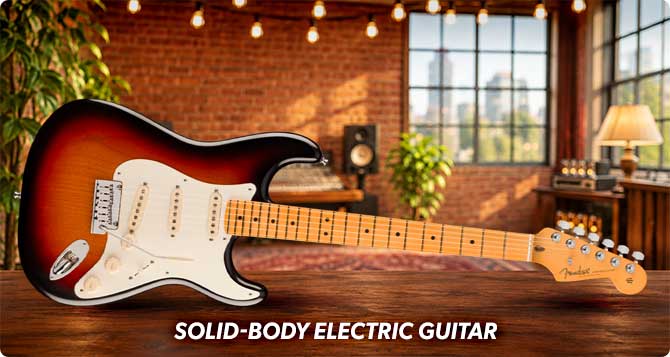
The solid-body electric guitar is the most popular type of electric by far. The body is a solid slab of wood (or occasionally another material), with no sound hole or hollow chambers. That makes it highly resistant to feedback at high volumes and gives it plenty of sustain, which is why it rules rock, metal, blues, punk, and pop.
A solid-body’s sound is shaped mostly by its pickups, your amp, and your effects:
- Single-coil pickups: Bright, clear, and snappy, though they can pick up some background hum.
- Humbuckers: Thicker, warmer, and more powerful, with the hum canceled out. Great for heavier styles.
- P-90s: Somewhere in between, with a raw, gritty bite.
Solid-bodies also come in a huge range of body shapes, from the Stratocaster, Telecaster, Les Paul, and SG to offsets like the Jazzmaster and pointy metal shapes like the Flying V and Explorer. Each looks and feels different, but they all work on the same principles.
The main downside is that you’ll need an amp, which adds to the cost. Take a look at my picks for the best beginner guitar amps if you’re starting out. Some solid-bodies, especially Les Paul-style guitars, can also be heavy on your back during long sessions.
Best for: Rock, metal, blues, punk, pop, and pretty much anything that needs to get loud.
Famous solid-body players include Jimi Hendrix, Eddie Van Halen, Jimmy Page, Eric Clapton, David Gilmour, and Slash.
Lefties, check out my guide to the best left-handed electric guitars for beginners.
7. Semi-Hollow Guitars: The Best of Both Worlds
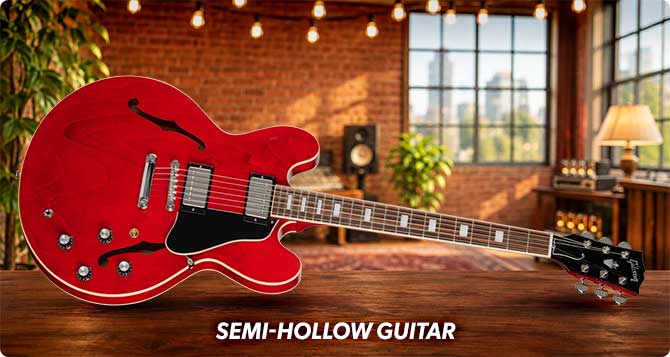
A semi-hollow guitar (sometimes called a semi-acoustic) sits halfway between a solid-body and a fully hollow electric. Its thin body has hollow chambers on either side, with a solid block of wood running down the middle and f-holes on the top.
That center block is what makes it work. The hollow wings add warmth, air, and resonance, while the solid core cuts down on feedback and keeps the sustain strong. The result is a guitar that can handle a clean jazz chord and a crunchy rock riff with equal ease.
The design was made famous in the late 1950s by the Gibson ES-335 (shown above), which is still the template for most semi-hollows today. You’ll also find chambered guitars, which look like solid-bodies but have hollow pockets routed inside to add a touch of airiness and cut weight.
The trade-offs are a larger body than most solid-bodies, which can feel bulky at first, and a tendency to feedback at very high volume or gain. They’re not the best choice for extreme metal, but they’re impressively versatile for almost everything else.
Best for: Blues, jazz, classic rock, indie, and anyone who wants one guitar that can cover a lot of ground.
Famous semi-hollow players include B.B. King, Chuck Berry, Alvin Lee, Dave Grohl, and Noel Gallagher.
Lefties, see my guide to left-handed semi-hollow guitars.
8. Hollow-Body and Archtop Guitars: Warm and Woody
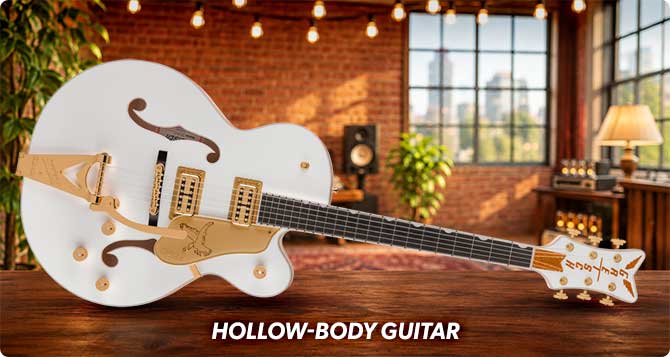
A hollow-body guitar is fully hollow inside, with no center block, which gives it a warm, round, woody tone that’s closer to an acoustic than any other electric. Most have f-holes, and you can hear them reasonably well unplugged.
Many hollow-bodies are archtops, with a top that’s carved or pressed into a gentle arch, like a violin. The archtop came first as a loud acoustic guitar for jazz bands in the 1920s, and adding pickups in the 1930s helped turn the guitar into a lead instrument. You can still buy acoustic archtops without pickups today.
Classic jazz boxes have deep bodies and a rich, mellow sound that’s perfect for smooth chords and clean single-note lines. There are also thinline hollow-bodies, which are shallower and a little more rock-friendly. Rockabilly players love big hollow-bodies for their twang and slapback-friendly snap.
The big drawback is feedback. With no center block, hollow-bodies can howl at high volume or with lots of gain, so they’re not built for heavy styles. Deep bodies can also feel bulky, and they’re a little more delicate than a solid-body.
Best for: Jazz, rockabilly, swing, blues, and vintage-style tones.
Famous hollow-body players include Charlie Christian, Wes Montgomery, Joe Pass, George Benson, Chet Atkins, and Brian Setzer.
Lefties, check out my guide to left-handed hollow-body guitars.
9. Extended-Range Guitars: 7, 8, and Beyond
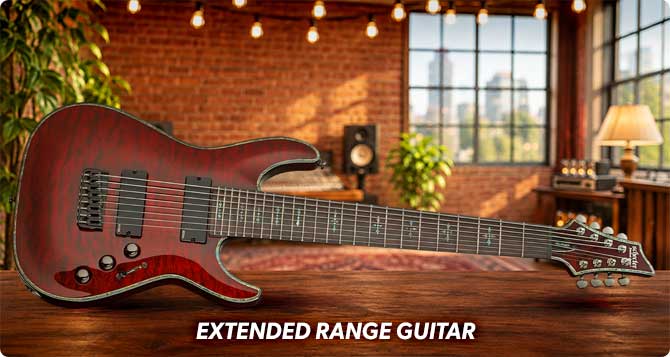
Extended-range guitars have more than six strings, adding extra low (or occasionally high) notes to the standard range. The most common are:
- 7-string: Adds a low B below the low E (B E A D G B E).
- 8-string: Adds a low F# below that (F# B E A D G B E).
- 9-string and beyond: Rarer, usually adding an even lower string or a high A.
Jazz players experimented with 7-strings for decades, but extended-range guitars really took off in metal in the 1990s, and they’re now a staple of djent, progressive metal, and modern heavy music. The extra low strings give you crushing riffs without having to detune your guitar, plus wider chord voicings and more range for solos.
Many extended-range guitars use a longer scale length to keep those low strings tight and punchy, and some use a multiscale design, which I’ll cover shortly.
The downsides are a wider, chunkier neck, more strings to mute when you don’t want them ringing, and fewer songs and lessons written for them. You may also need to hunt a little harder for the right string sets.
Best for: Metal, djent, progressive rock, and any player who wants a lower, heavier range.
Famous extended-range players include Steve Vai, John Petrucci, Munky of Korn, Tosin Abasi, and Misha Mansoor.
Need some inspiration? Check out my lists of the best 7-string guitar songs and best 8-string guitar songs. Lefties can also browse my guides to left-handed 7-string guitars and left-handed 8-string guitars.
10. Baritone Guitars: Lower, Darker, Heavier
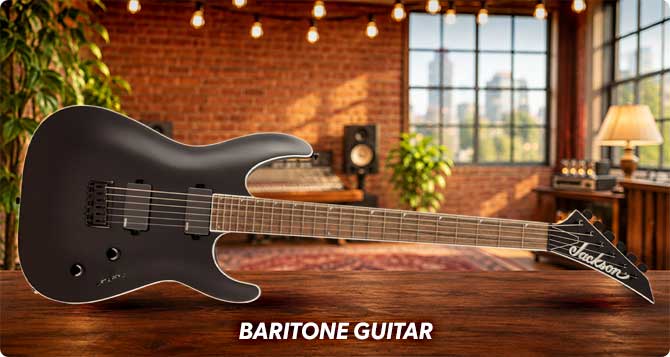
A baritone guitar is a 6-string with a longer scale length, built to be tuned much lower than a standard guitar. Instead of adding extra strings like a 7- or 8-string, it shifts the whole range down, so you get a deeper, darker sound while keeping all your familiar chord shapes.
Baritones usually have a scale length somewhere between about 27 and 30 inches, compared to around 24.75 to 25.5 inches on a regular guitar. That extra length, plus heavier strings, keeps the low notes tight instead of floppy. The most common tunings are:
- B standard: B E A D F# B, a fourth below standard tuning.
- A standard: A D G C E A, a fifth below standard tuning.
You’ll hear baritones in metal and heavy rock, but they also have a long history in surf, country, and moody, cinematic soundtrack music. Baritone acoustics are around too, and they have a big, rich sound for fingerpicking.
The downsides are the longer stretches between frets, heavier strings to push around, and the fact that songs you know will sound in a lower key when you play the usual shapes. There are also fewer models to choose from than standard guitars.
Don’t confuse a baritone with a Bass VI. A Bass VI is also a 6-string with a long scale, but it’s tuned a full octave below a standard guitar, putting it in bass territory.
Best for: Heavy riffs, surf, country, ambient and soundtrack work, and anyone who wants a deeper sound without extra strings.
Lefties, take a look at my guide to left-handed baritone guitars.
11. Multiscale Guitars: Fanned Frets for Better Tension
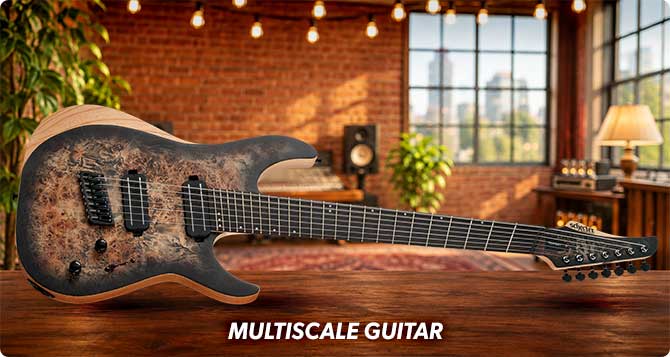
A multiscale guitar, also called a fanned-fret guitar, gives each string its own scale length. The low strings are longer and the high strings are shorter, so the frets, nut, and bridge all sit at an angle across the neck. It looks a bit wild the first time you see one.
The idea is to give every string its ideal tension. Longer low strings stay tight and clear, which is a big deal on 7- and 8-strings and in low tunings, while shorter high strings stay slinky and easy to bend. Many players also find the angled frets more comfortable, since they follow the natural angle of your fretting hand.
Fanned frets have become especially popular in progressive metal and djent, but you’ll find them on 6-strings for all kinds of styles. One fret, usually somewhere around the middle of the neck, is set straight across, and the frets fan out from there.
Most players adjust to the feel surprisingly quickly, but there are a few trade-offs. There are fewer models to choose from, replacement parts like bridges are more specialized, and you may need a special capo to fit the angled frets. They also tend to cost more than standard guitars.
Best for: Extended-range guitars, low tunings, progressive metal, and players chasing even string tension.
Players known for multiscale guitars include Tosin Abasi and Plini.
Lefties, check out my guide to left-handed Strandberg guitars, one of the best-known multiscale brands.
Other Types of Guitars
These guitars don’t fit neatly into the acoustic or electric camps. Some are close relatives with a different job, and others are built for specific situations or styles, or are just plain unusual.
12. Bass Guitars: Holding Down the Low End
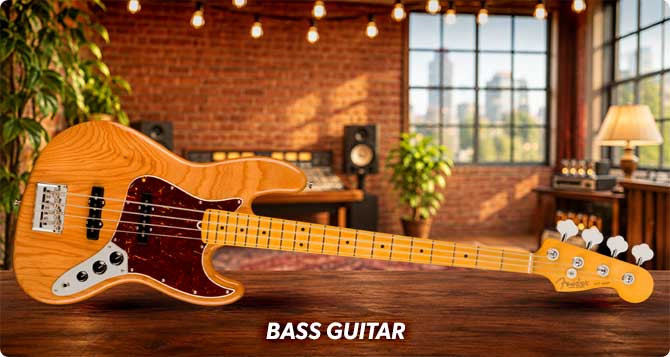
The bass guitar is a close relative of the guitar rather than a type of guitar, but it’s worth a mention. A standard bass has four thicker strings tuned E A D G, an octave below the lowest four strings on a guitar, and its job is to lock in with the drums and anchor the band.
Basses come in plenty of varieties of their own, from 5- and 6-strings to fretless and short-scale models. I cover them all in my full guide to the types of bass guitars.
13. Lap Steel and Pedal Steel Guitars: Smooth and Singing
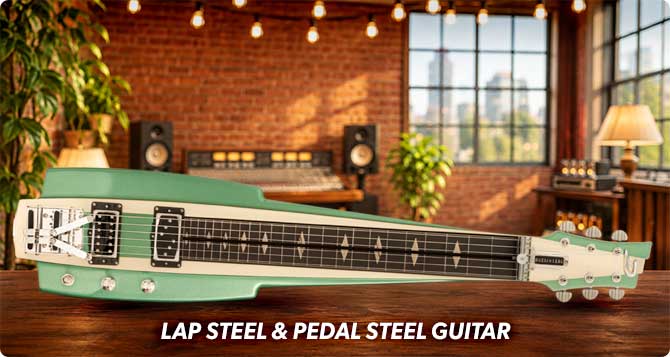
Lap steel guitars are played flat, either across your lap or on a stand. Instead of pressing the strings down with your fingers, you glide a heavy metal bar (called a steel or tone bar) along them, picking with fingerpicks. The strings sit high above the fretboard, so the bar never touches it, and the frets are just markers to show you where the notes are.
The style started in Hawaii in the late 1800s, and the result is a smooth, gliding, vocal-like sound. One of the very first electric guitars, Rickenbacker’s “Frying Pan” from the early 1930s, was actually a lap steel. Most lap steels are tuned to an open chord, so you can play a full chord with the bar laid straight across the strings.
Pedal steel guitars take the idea much further. They sit on legs, often have two necks with 10 strings each, and use floor pedals and knee levers to change the pitch of certain strings while you play. That’s how they create the crying, swooping chords that define classic country music. Square-neck resonators, which I covered earlier, are played in a similar lap-style way.
The trade-off is that both require a completely different technique from regular guitar, so your existing skills won’t transfer as much as you’d hope. Lap steels are fairly affordable and simple to get started on, but pedal steels are expensive, complicated, and famously tricky to master.
Best for: Country, Hawaiian, blues, gospel, and anyone who loves that sweet, sliding sound.
Famous steel players include Jerry Byrd, Speedy West, Buddy Emmons, and Robert Randolph.
14. Travel and Short-Scale Guitars: Small but Mighty
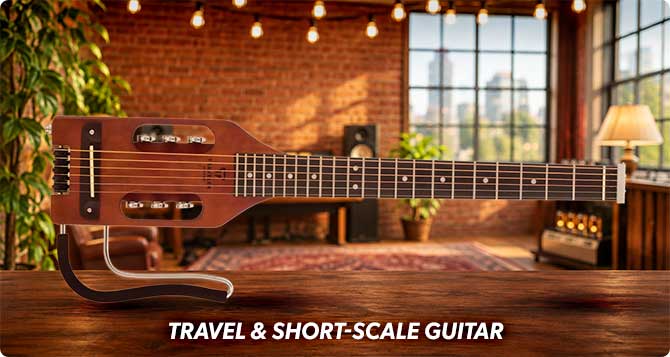
Travel and short-scale guitars are smaller versions of regular guitars, built to be easier to carry, easier to reach around, or both. This group covers a few different ideas:
- Travel guitars: Compact acoustics and electrics designed to fit in an overhead bin or a backpack. Some take it further with folding necks or tiny, stripped-back bodies.
- 3/4 and 1/2 size guitars: Scaled-down guitars for kids, with smaller bodies and shorter necks to match smaller arms and hands.
- Short-scale guitars: Full-size players’ instruments with a scale length of around 24 inches or less, compared to the usual 24.75 to 25.5 inches. The frets are closer together, and the strings feel a little slinkier.
Smaller guitars are lighter, more comfortable for small hands, and easy to take anywhere. Short-scale electrics have a cult following of their own, too. Kurt Cobain’s go-to guitar was the short-scale Fender Mustang, and Ed Sheeran made his name playing a 3/4 size Little Martin acoustic.
The trade-offs are that smaller acoustic bodies have less volume and bass, and the lower string tension can feel a little floppy, especially with heavier playing. Kids will also eventually outgrow a 3/4 or 1/2 size guitar.
Best for: Traveling, kids, players with smaller hands, and anyone who wants a comfortable guitar to keep by the couch.
Lefties, check out my guides to left-handed travel guitars and left-handed guitars for kids and smaller hands.
15. Unusual Guitars: The Weird and Wonderful
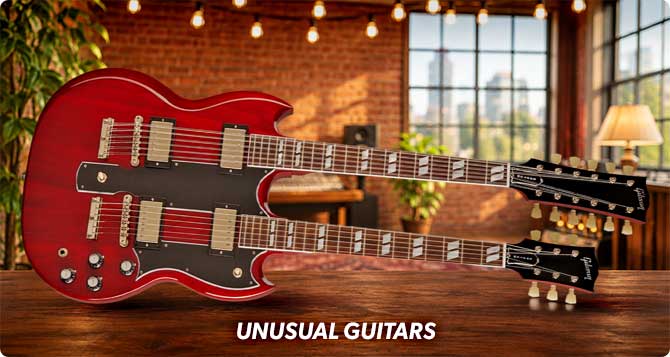
And then there are the guitars that don’t fit anywhere else. Some solve a real problem, some are built for showing off, and some exist mostly to look amazing on an album cover. Here are a few you might come across:
- Double-neck guitars: Two necks on one body, usually a 12-string and a 6-string, so you can switch between them mid-song without changing guitars. Jimmy Page’s Gibson double-neck is the most famous example.
- Harp guitars: A regular guitar with extra unfretted strings on an added arm, which ring out as open bass notes (or treble notes) alongside your playing. Michael Hedges made them famous in modern acoustic music.
- Headless guitars: Guitars with the tuners moved to the bridge and the headstock removed entirely. Popularized by Steinberger in the 1980s and Strandberg today, they’re lighter, better balanced, and easy to travel with.
- Tenor guitars: Smaller 4-string guitars, originally designed for banjo players in the 1920s, and still popular in folk and Celtic music.
- Chapman Stick: Not technically a guitar, but often mistaken for one. It’s a long, fretted board played by tapping both hands on the strings, covering bass and melody at once.
Most of these are specialist instruments rather than everyday choices, though headless guitars have become a genuinely popular option for modern players.
Want to see some truly bonkers designs? Check out my roundup of 17 crazy guitar designs.
Which Type of Guitar Is Best for Beginners?
My advice is simple: start on the type of guitar you actually want to play. You’ll often hear that beginners should start on a classical guitar because the nylon strings are softer on your fingers, but there’s no point if all you want to do is play Metallica. You’ll practice more, and stick with it longer, if the guitar in your hands sounds like the music you love.
That said, a couple of things are worth keeping in mind. Younger players and anyone with smaller hands may find a 3/4 size or short-scale guitar more comfortable to start on. And if you go electric, remember to budget for an amp.
For more tips on picking your first instrument, check out my guide to buying your first guitar.
Left-Handed Guitars
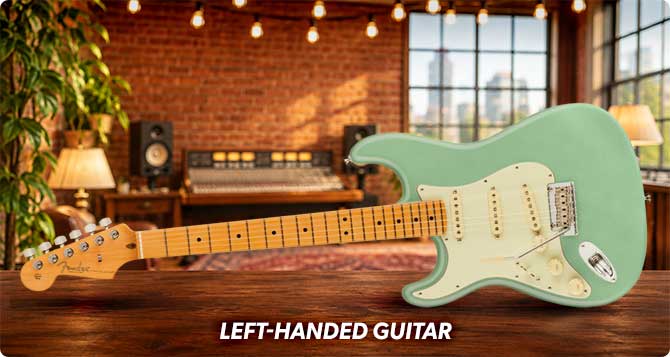
Almost every type of guitar in this guide is available left-handed, from acoustics and classicals to extended-range and multiscale electrics. The choice gets thinner for niche types like resonators and baritones, but it’s there if you know where to look.
Not sure whether to play left- or right-handed? Read my guide on whether you should learn guitar right- or left-handed. And when you’re ready to shop, my left-handed guitar store directory lists the best places to find one.
Final Thoughts on the Different Types of Guitars
From the trusty steel-string acoustic to the wonderfully over-the-top double-neck, every type of guitar has its own sound and personality. The right one for you is the one that makes you want to pick it up every day.
If you enjoyed reading about the different types of guitars, you’ll also love these posts!

