
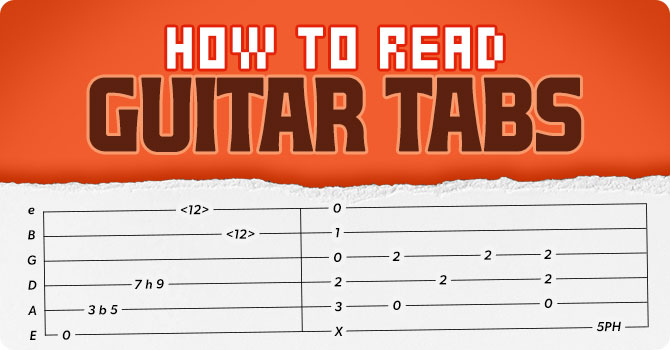
Learning how to read guitar tabs is the quickest way to start playing real songs, and you can get the hang of it in one sitting. This guide explains what the lines and numbers mean, how riffs and chords are written, and what all those little symbols are asking you to do.
Tab (short for tablature) shows you which string to play and which fret to press, so you don’t need to know any music theory to use it. It’s what you’ll find on almost every guitar song website, and most guitar songbooks print it alongside standard notation.
I learned from tab myself, so I know where beginners get stuck. Tab does leave out some important information, like rhythm, and I’ll show you how to fill in those gaps so you don’t learn a song slightly wrong without realizing it.
Jump to:
- What guitar tab is and how the lines work
- How to read notes and riffs
- How chords look in tab
- Guitar tab symbols
- What tab doesn’t tell you
- Tunings and capos in tab
- How to read bass tabs
- Reading tab as a left-handed guitarist
What Guitar Tab Is (and How the Lines Work)
Guitar tab is a simple map of the fretboard. The six horizontal lines are your guitar’s six strings, and the numbers on them tell you which fret to finger.
The bottom line is the thickest string (low E), and the top line is the thinnest (high E). Most tabs label each line with its string name on the left, usually written as e, B, G, D, A, E from top to bottom. The lowercase e just separates the high E string from the low one.
If that looks upside down, think of it this way: when you look down at your guitar while playing, the low E is closest to you, so it sits at the bottom of your view. Tab is drawn the same way.
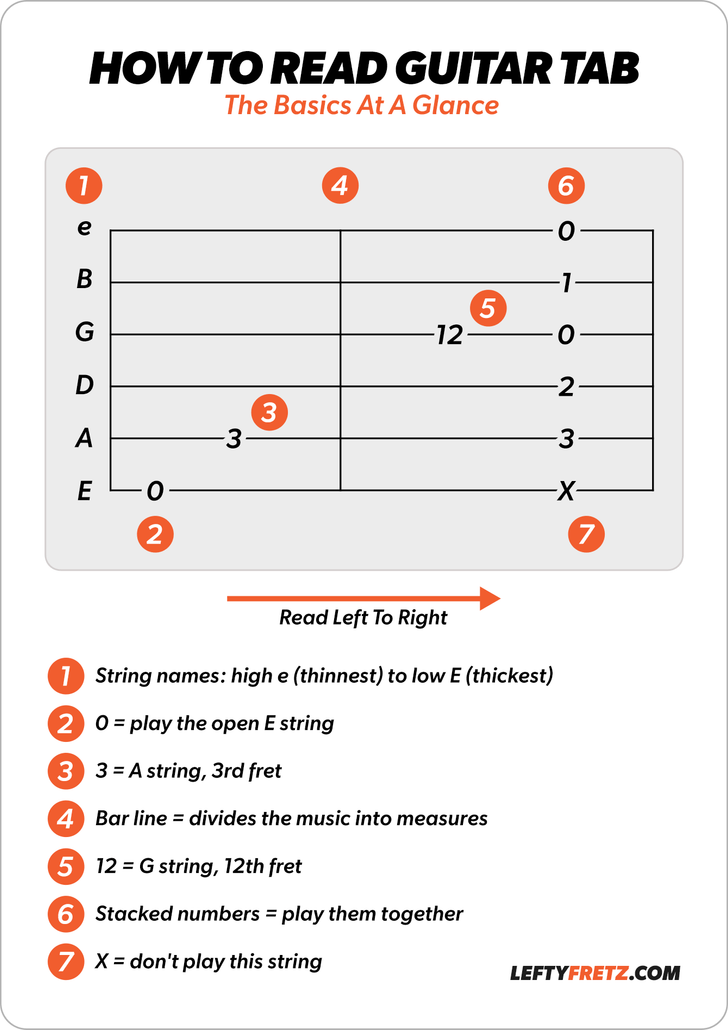
The numbers are frets, not fingers. A 3 on the A string means press the A string at the third fret and pick it. A 0 means play the string open, without fretting it. Standard tab doesn’t tell you which finger to use, so that part is up to you.
Tab is read from left to right. Numbers that come one after another are played one at a time, and numbers stacked directly on top of each other are played together. The vertical lines you’ll see every so often are bar lines, which divide the music into measures.
The string names above are for standard tuning. If a song uses a different one, the tab should say so at the top, and I’ll show you how to handle that later on. Curious why guitars use those notes in the first place? Here’s why standard guitar tuning is EADGBE.
How to Read Notes and Riffs in Tab
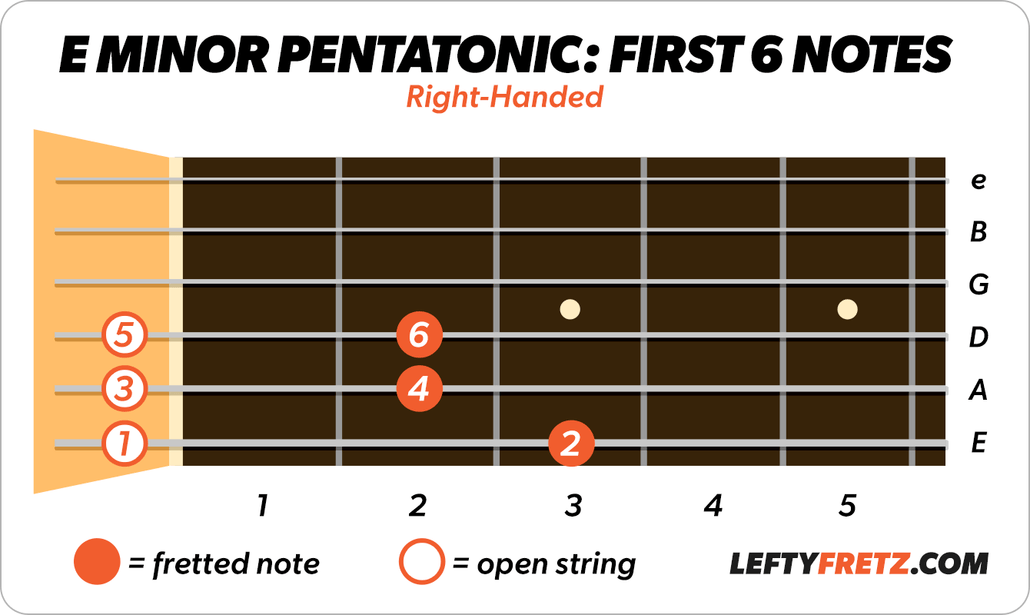
Most riffs and solos are written as single notes, one after another. Here’s a short example to try. It’s the first six notes of the E minor pentatonic scale, a pattern that turns up in countless rock and blues riffs.
e|-----------------------|
B|-----------------------|
G|-----------------------|
D|--------------0--2-----|
A|--------0--2-----------|
E|--0--3-----------------|
Starting from the left, here’s what to play:
- Low E string, open
- Low E string, 3rd fret
- A string, open
- A string, 2nd fret
- D string, open
- D string, 2nd fret
Here’s what it looks like on your fretboard:
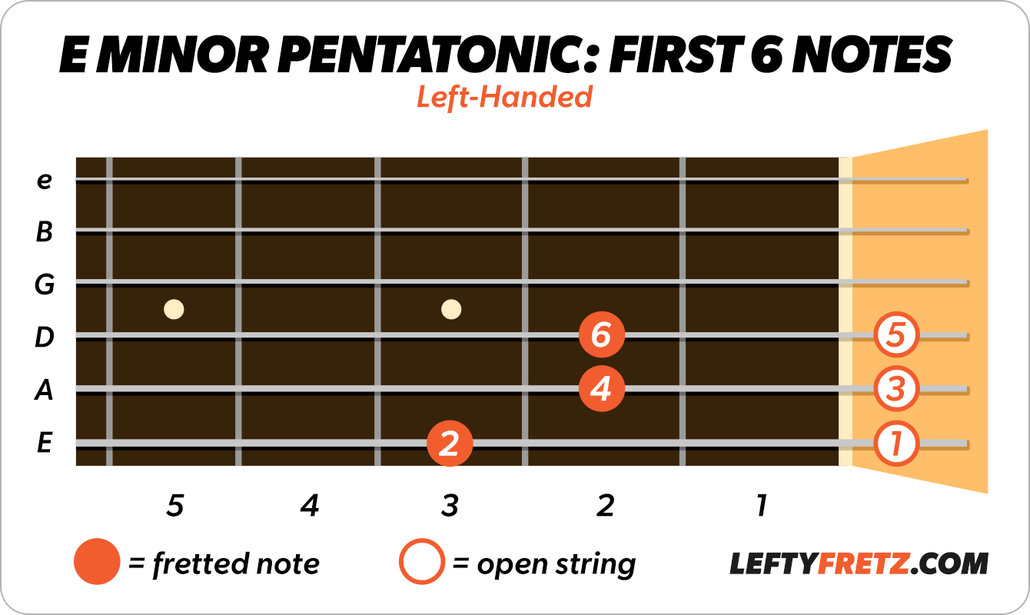
Play it slowly at first, saying each string and fret out loud if it helps. Once you can play it without stopping, try it in reverse, from the D string back down to the low E.
Lefties who want to learn the whole scale can check out my left-handed minor pentatonic scale lesson.
How Chords Look in Tab
Numbers stacked directly on top of each other are played at the same time. Three or more stacked notes make a chord, so strum those strings together. Two stacked notes are usually called a double stop, which you’ll see a lot in blues and rock solos. The chord name is often written above the tab, too, so you can check it against a chord chart.
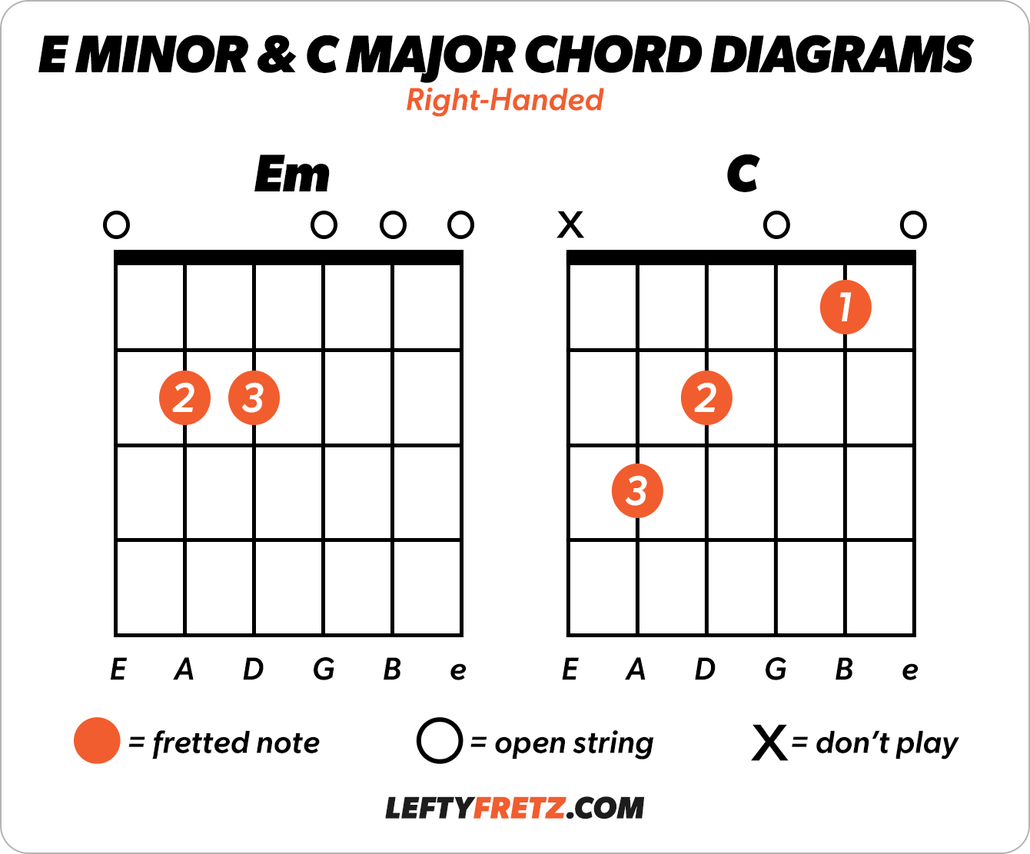
Here’s E minor followed by C major:
    Em    C
e|--0-----0--|
B|--0-----1--|
G|--0-----0--|
D|--2-----2--|
A|--2-----3--|
E|--0-----x--|
Read each chord from the bottom line up. For E minor, you play the low E string open, the A and D strings at the 2nd fret, and the G, B, and high E strings open.
The x on the low E string in the C chord means that string is muted, so it shouldn’t ring out. Either avoid hitting it with your pick, or rest a fingertip lightly on it to deaden it. You’ll also see x in riffs, where it works a little differently. I cover that in the symbols section below.
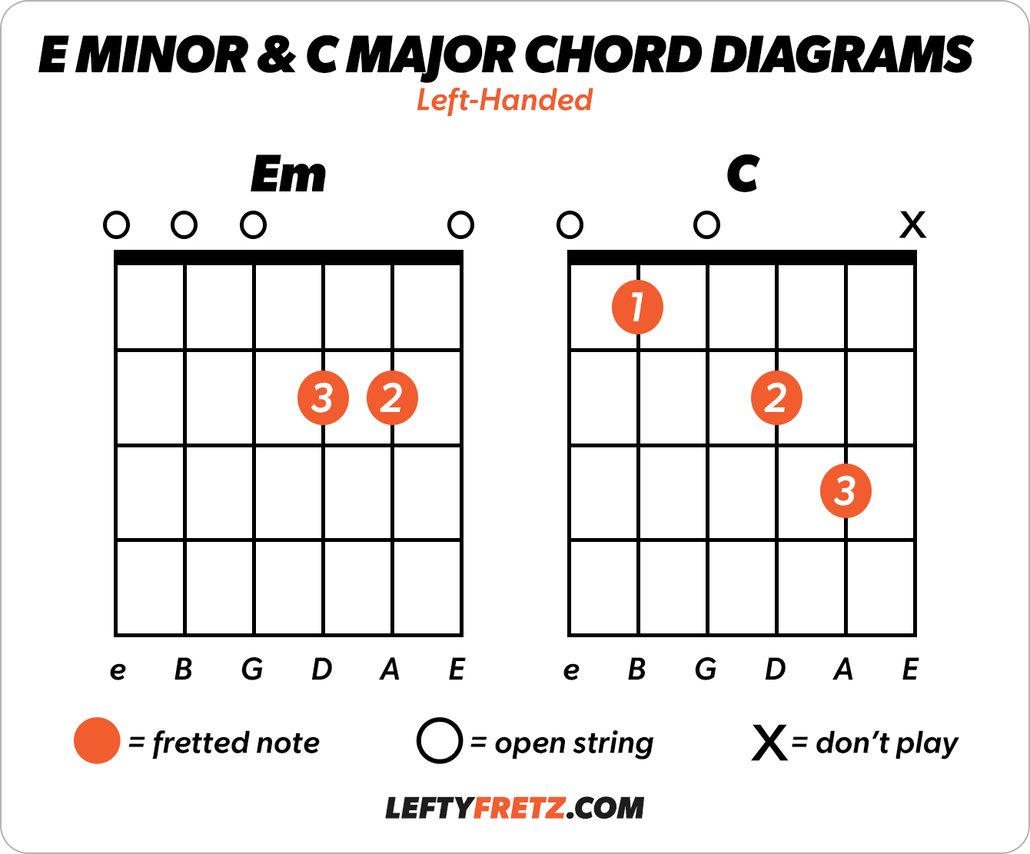
Here’s what they look like in chord diagram form.
If the numbers of a chord are spread out one after another instead of stacked, hold the whole chord shape and pick the strings one at a time. This is called an arpeggio, and it’s common in ballads and fingerpicked songs.
Keep in mind that a lot of song websites offer “chords” versions as well as tabs. Those show chord names above the lyrics rather than full tab, which is often all you need for strumming along. If you’d like to write out your own chord shapes, grab my free blank guitar chord charts.
Guitar Tab Symbols
Numbers tell you where to play, and the letters and symbols around them tell you how. These are the ones you’ll see most often:
| Symbol | Meaning | Example |
|---|---|---|
| h | Hammer-on: pick the first note, then press down on the higher fret without picking again | 5h7 |
| p | Pull-off: pick the first note, then pull your finger off to sound the lower fret | 7p5 |
| b | Bend: push the string until it sounds like the fret shown after the b | 7b9 |
| r | Release: let a bent string return to its normal pitch | 7b9r7 |
| / | Slide up to the higher fret | 5/7 |
| \ | Slide down to the lower fret | 7\5 |
| ~ | Vibrato: shake the note slightly with your fretting hand | 7~~ |
| x | Muted or “dead” note: in a chord, don’t let that string ring out. In a riff, pick it while your fretting hand rests lightly on the string for a percussive “chk” sound | x |
| PM | Palm mute: rest the edge of your picking hand lightly on the strings right next to the bridge as you pick. It gives a tight, chugging sound used in a lot of rock and metal. The dashes show how long to keep muting | PM—- |
| < > | Natural harmonic: touch the string lightly, directly above the fret wire (not between frets), and pick it. It gives a clear, bell-like chime. | <12> |
| PH | Pinch harmonic: catch the string with your thumb as you pick to make it squeal | 5 PH |
| t | Tap: hammer onto the fret with a finger of your picking hand | t12 |
| ( ) | Ghost note: a note played very softly, or a note carried over from before | (5) |
| x2 | Repeat the section the number of times shown | x2 |
Here’s how a few of them look together on one string:
e|-------------------------|
B|-------------------------|
G|--5h7p5---7b9r7---5/7~~--|
D|-------------------------|
A|-------------------------|
E|-------------------------|
Pick the 5th fret, hammer on to the 7th, then pull off back to the 5th. Next, pick the 7th fret, bend it up until it sounds like the 9th, and let it back down. Finally, pick the 5th fret, slide up to the 7th, and add some vibrato.
Not every tab writer uses the same symbols. Some write slides as “s” and bends as “7b(9)” or “7b full,” and online tabs vary even more than printed songbooks. Most tabs include a key if they use anything unusual, so check there first.
What Tab Doesn’t Tell You
Tab is brilliant for showing where to play. The catch is that it leaves out a lot about how and when to play.
Rhythm is the big one. Standard tab doesn’t tell you how long each note lasts or exactly when to play it. The spacing between numbers sometimes hints at the timing, but tab writers aren’t consistent, so don’t rely on it. The fix is simple: listen to the recording, and play along with it once you’ve got the notes down.
Some tabs do include rhythm. Published songbooks often print rhythm markings under the tab, and tab apps like Songsterr and Guitar Pro play the tab back so you can hear how it should sound. Both are a big help when you can’t work out a tricky part by ear.
Not all tabs are accurate. Most tabs online are written by other players working things out by ear, and some are better than others. If a tab sounds wrong against the recording, it probably is. Check the ratings, compare a couple of versions, and trust your ears over the numbers.
Even a correct tab may not match how the original was played. The same note can be found in several places on the neck, so a tab writer might put a riff in a different position than the guitarist used. If a part feels awkward, try finding the same notes somewhere more comfortable.
Tab vs standard notation. Standard notation shows pitch and rhythm in detail but not where to play on the neck. Tab shows exactly where to play but not the rhythm. That’s why many songbooks print both, one above the other.
If you want to play jazz or classical guitar, or read charts in a band or session setting, standard notation is worth learning. For most rock, pop, and blues playing, tab and a good pair of ears will get you a long way.
Tunings and Capos in Tab
Alternate tunings. If a song isn’t in standard tuning, the tab should tell you at the top, usually with the tuning name, the string notes, or both. The string labels on the left often change to match. Here’s a tab in drop D, one of the most common alternate tunings, where you tune the low E string down to D:
Tuning: Drop D (D A D G B E)

e|-----------|
B|-----------|
G|-----------|
D|--0-----5--|
A|--0-----5--|
D|--0-----5--|
The fret numbers work exactly the same way. A 0 on the bottom line just means your low string is now an open D rather than an E. In drop D, the bottom three strings form a power chord, so you can play one with a single finger across the same fret. Try playing this tab in standard tuning and it’ll sound off, which is why it’s always worth checking the tuning before you start.
Capos. If a song uses a capo, the tab will usually say so at the top, for example “Capo 2nd fret.” In most tabs, the fret numbers are counted from the capo, not the nut. So a 0 means the fret where the capo sits, and a 2 means two frets above the capo. If the numbers don’t seem to fit, check whether the tab says otherwise.
New to capos? My guide to what a capo is and how to use one covers the basics.
How to Read Bass Tabs
Bass tab works exactly like guitar tab, just with fewer lines. A standard 4-string bass tab has four lines, with the low E string at the bottom and the G string at the top. As with guitar tabs, the numbers are frets, 0 is an open string, and you read from left to right.
Here’s a simple pattern that’s all over rock and pop bass lines: the root, the fifth, and the octave.
G|-----------|
D|--------2--|
A|-----2-----|
E|--0--------|  x2
Play the open E string, then the 2nd fret on the A string, then the 2nd fret on the D string, and repeat.
Extended-range basses just add lines. A 5-string bass tab usually has a low B line at the bottom, and a 6-string adds a high C at the top. As with guitar, check the string labels on the left before you start.
Bass tabs use mostly the same symbols as guitar tabs, plus a few of their own for slap bass, such as “T” for thumb slaps and “P” for pops. These vary even more between tab writers than guitar symbols, so look for a key.
If you want to write out your own bass lines, grab my free printable bass tab paper. And if you’re still choosing an instrument, my guide to the types of bass guitars covers the options.
Reading Tab as a Left-Handed Guitarist
Good news, lefties: tab is universal. It tells you which string and which fret, not which hand, so the same tab works whether you play left-handed or right-handed. That makes it a lot easier to learn from than right-handed chord diagrams, which you have to flip in your head.
The exception is if you play upside down: a left-handed guitar with the strings left in right-handed order, so the high E is at the top nearest your face. The tab doesn’t change, since the bottom line is still the low E and the numbers are still frets. But the trick of picturing the tab as the neck you see when you look down no longer works, because your strings are in the opposite order. Read the string names rather than the line positions, and chord shapes from tab will look different on your neck than they do on everyone else’s.
Plenty of great players have done it this way, so you’re in good company. See my list of guitarists who play upside down. And if you’re after chord shapes drawn the right way round for a lefty, my left-handed guitar chords book has them all mirrored for you.
Start Practicing
The quickest way to get comfortable with tab is to use it on songs you actually want to play. Pick something simple, learn it a few bars at a time, and play along with the recording as soon as you can. My list of easy guitar songs is a good place to find one.
Writing your own tab helps too. Jot down riffs you come up with, or try tabbing out a simple song by ear. It makes you think in strings and frets the same way a tab writer does, and you’ll get quicker at reading tabs as a result. My free blank guitar tab sheets are ready to print.
Want to put those E minor pentatonic notes from earlier to use? Pick a jam track in E minor from my guitar jam tracks list and improvise over it. And if you’d like more structure, my roundup of free guitar lessons for beginners is the next stop.

